Books
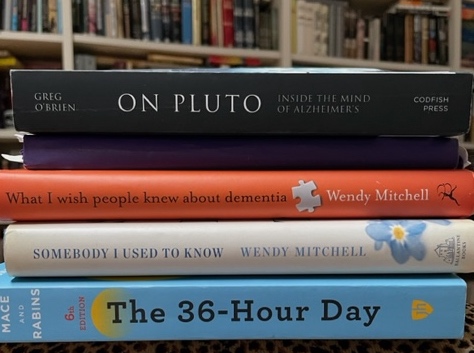
The 36-Hour Day: A Family Guide to Caring for People Who Have Alzheimer Disease and Other Dementias (A Johns Hopkins Press Health Book) by Nancy L. Mace and Peter V. Rabina
On Pluto: Inside the Mind of Alzheimer’s by Greg O’Brien and Lisa Genova
Somebody I Used To Know: A Memoi by Wendy Mitchell
Thoughtful Dementia Care: Understanding The Dementia Experience by Jennifer Ghent-Fuller
What I Wish People Knew About Dementia: From Someone Who Knows by Wendy Mitchell
Community
Alzheimer’s Association: A nonprofit that focuses on care, support and research.
AlzConnected: An online forum of fellow caregivers, hosted the Alzheimer’s Association.
Caring Transitions: A national moving company specializing in sensitive relocations.
Dementia Care Central: An interactive resource site for dementia caregivers.
Guidance
Aging Care Questions links to an open forum discussing commonly cited statistics about the health burden on caregivers of PwDs; the comments have lots of information and links.
Alzheimer’s: Clinical Stages links to detailed charts of the seven clinical stages of the disease. During my sister’s illness, I referred to this information a lot.
Alzheimer’s & Dementia Stages/Scales links to various metrics (GDS, FAST, CDR) professionals use to measure cognitive deterioration in persons with dementia. It includes extensive, detailed checklists plus a chart with life expectancy information. The latter was actually essential to me in determining some ballmark numbers, so that I could financially plan for my sister’s care.
Alzheimer’s Disease Caregivers [PDF] is a fact sheet for caregivers that is jam-packed with statistical information. It provides an interesting perspective and overview.
Caregiving Can Kill You! links to a wonderful resource article, featuring great pie charts and statistics; it emphasizes the importance of self care for caregivers of PwDs.
Caregiving can test you, body and soul. It can also unlock a new sense of self. This is a great article about caregiving. Its message is so good, and so true. It really resonated with me, and I think it’ll resonate with a lot of people who have become caregivers.
Dementia and Caregiver Burden links to an informative, three-year longitudinal study showing the impact on caregivers of PwDs. The abstract is a pretty easy read.
Forgive Yourself is a detailed article that offers four key pieces of good, practical advice—for caregivers, from caregivers. It also has a Podcast version.
Hospice Admissions Guidelines links to comprehensive overview of everything a caregiver would need to consider when contemplating hospice care for their PwD.
Life Expectancy Calculator offers similar information for caregivers, but with links tailored specifically for persons with with frontotemporal dementia.
The Nine Most Common Dementias links to an informative video featuring gerontologist and dementia expert Tam Cummings, PhD, who compares the symptoms and progression of the most common types in a clear, helpful format. An important resource for caregivers.
When Death Is Near is a resource page from the Hospice Foundation. It provides detailed information so that caregivers can recognize the signs and symptoms when their loved one may be beginning the process of transitioning from life to death.
When Is it Time? is another good hospice advice page.
Keywords
Alzheimer’s disease is a neurodegenerative disease that is the most common form of dementia. Symptoms may begin slowly but progressively worsen.
Anosognosia is a condition in which a person with dementia is cognitively unaware of it; essentially the person forgets they have dementia.
Dementia is an acquired brain condition that is characterized by a progressive decline in cognitive abilities such as memory, thinking, motor control, and language. It can be caused by several diseases or injuries, including Alzheimer’s.
Durable Power of Attorney (DPOA) documents authorize a trusted person to handle legal matters on behalf of someone who has become incapacitated. If you are a caregiver for a person with dementia (PwD), you need to get this as soon as possible.
Early-onset Alzheimer’s is the name for Alzheimer’s when it occurs in someone younger than 65. It is a much rarer form that can impact people in their 40s and 50s.
Frontotemporal dementia (FTD) refers to several types of dementia that involve the progressive degeneration of the brain’s frontal and temporal lobes.
Mild cognitive impairment (MCI) refers to cognitive changes that are typically found in persons with dementia (especially due to Alzheimer’s); they differ from normal aging.
Primary progressive aphasia (PPA) is a type of neurological impairment in which a person’s ability to speak, read, write, and comprehend language progressively worsens.
PPA’s logopenic variant variant is characterized by slower speech, difficulties with word retrieval, and retaining (and understanding) complex verbal information.
Shadowing is when a person with dementia uses a trusted caregiver as an anchor to stay oriented as their world becomes increasingly confusing.
Showtiming is when your PwD manages to pull it together enough to show others (often a doctor) that they are just fine, that there is nothing wrong them—certainly not dementia!
Sundowning refers to a neurological phenomenon in which a person with dementia becomes more restless and confused in the late afternoon and evening.
Legal
Determining Competency to Sign a Durable Power of Attorney is a great resource that explains the process, requirements, and best practices for obtaining this critical legal tool.
The process of obtaining a DPOA varies from state to state. For example, I used the California Uniform Statutory Form [PDF], which has to be notarized, for my sister’s care.
Once you have a DPOA, you will want to register it with the IRS. That way, if you have questions about your loved one’s taxes, you will be able to speak to the government about them. Otherwise, privacy laws would prohibit the IRS from giving out tax information. The form I used to do this is a Power of Attorney and Declaration of Representative [PDF].
You may also want to register your DPOA with your state’s Franchise Tax Board as well. In California, the form is an Individual or Fiduciary Power of Attorney Declaration [PDF].
In addition to a DPOA, you will also need an Advance Health Care Directive [PDF] for your PwD. This link is for the form I used specifically in California.
Newer Articles
A birthday gift for a partner with dementia brings unexpected joy is an article whether you should buy presents for a loved one with dementia. The answer is “yes.”
A caregiver’s survival guide: Advice from people who’ve been there is a very good article with perspectives and suggestions from caregivers on who to rely on, how to build support networks and community, how to cope, and much more.
How elder care can rupture sibling relationships: ‘I didn’t have much choice’ is a great resource. Sibling relationships can fracture when one or more of you are caring for parents or other relatives, particularly when deciding who will be in charge of particular aspects of care. Forewarned is forearmed.
Living With Alzheimer’s by Darren Keith shares his observations living through this disease as he cares for his dad.
Older people risk mental decline if they do long hours of caring, UK study shows highlights some of the risks we caregivers face as we care for our loved ones.
Routine vaccines may cut dementia risk—experts have startling hypothesis on how is an interesting article about the relationship between dementia and vaccines. Consider keeping your vaccinations up to date, especially your shingles vaccinations.
Studying these young Alzheimer’s patients led to breakthroughs. Trump cut the funding is an article about DIAN families who have an inherited gene that virtually guarantees they will develop early-onset Alzheimer’s.
The New Age of Alzheimer’s is a special report by Scientific American on Alzheimer’s.
“What if I die first?” Making a plan is key for family caregivers. Here’s how lays out steps you can take to get plans in place so that you don’t have to worry later.
Why A Senior Caregiver Is Likely To Develop PTSD lays out the facts clearly. Caregiving is stressful, and developing PTSD because of it is a risk. Be aware of the signs.