
[TIMELINE: 2016–2018]
At the beginning of January 2018, I had the luxury of knowing next to nothing about dementia or Alzheimer’s Disease. Of course I’d heard of them, but I thought Alzheimer’s was mostly something that happened to very old people, and I figured it was mostly about just becoming forgetful. I’d never even heard of frontotemporal dementia (FTD) at all. I didn’t know what it meant that a person with dementia (PwD) could be considered stable or “on a plateau.” I knew nothing of the steep declines or gentle slides that PwDs could face during the course of their disease.
I didn’t know anything at all about the progression of these diseases—but in just a few months, I would learn more than I ever wanted to know.
Even though my sister’s official diagnosis would not take place until later on in 2018, it turned out that both Alzheimer’s and FTD had already been making their presence known to Peggy, even if she didn’t know exactly what was going on. A few of her closer friends and co-workers had already become familiar with the milder symptoms beginning to show up in her behavior.
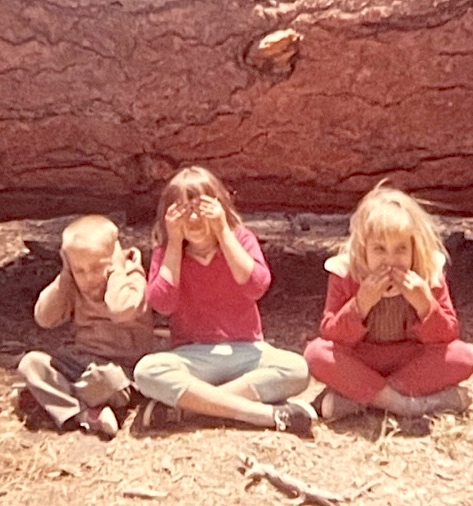
Looking back, I can admit that I’d seen a few little things myself beginning right around 2016, but nothing that clearly said, “Peggy has Alzheimer’s” to me. Those few earlier moments only made a slight impression on me because they were out of character for Peggy.
For example, in 2016 Peggy needed an outpatient procedure, and I volunteered to drive her to the hospital. Once they took her down the hall to get prepped, I settled in with my book in the waiting room. Not long after, a nurse approached me, exasperated. She needed to confirm if Peggy had had anything to eat or drink after midnight, but Peggy was vague on the details when asked, and could not provide a straight answer. Since I had spent the night before with her and knew she hadn’t consumed anything, I conveyed that to the nurse. The surgery was allowed to proceed.
Then, after I got Peggy back home and settled in, I realized the medications she’d been given were mysterious to her. She couldn’t organize them or remember to take them at their proper times. Our brother Les and I ended up sorting them out for her. We didn’t think too much of it when it happened—but in hindsight, these were our first red flags. At the time, Peggy and Les were living together again in our parents’ house, ever since Peggy retired and had given up her San Jose condo. Since I lived more than two hours away from them (in San Francisco), I asked Les to promise me that he would make sure she took all her medications correctly.

Another incident occurred during the holidays late in 2017. Our cousin Nikki called me to ask if my sister had developed a drinking problem, because while she was at Nikki’s house, Peggy had been slurring her words. Also, “the spaghetti sauce didn’t taste right,” Nikki said.
Spaghetti with homemade sauce is one of our family’s oldest Christmas Eve traditions. After our mom passed, the responsibility fell to Peggy and Nikki to make the sauce; they would work together on this in Nikki’s huge kitchen. The idea that Peggy’s cooking wouldn’t taste right was ludicrous to me—but I also knew she didn’t have a drinking problem, so the whole situation was pretty disconcerting. That’s when we began quietly wondering if maybe Peggy had experienced a small stroke at some point, though she seemed fine physically.
Shortly after the holidays, in mid-January, another moment caught my attention. I was over at my parents’ house doing more work to wrap up their estate, and Les and I got into a (tense, but civil) disagreement over some details. Yet Peggy perceived the conflict as much worse than it was, and became quite upset. I immediately ended the argument. I was afraid she might get even more upset if Les and I continued, and thought it best to finish our discussion elsewhere (and in private).
I didn’t understand her emotional reaction; she was near tears. That was one of the first concrete examples of strange behavior in Peggy that I witnessed with my own eyes. I was worried, but Alzheimer’s Disease never even entered my thoughts as a possibility.
Finally, in mid-February 2018, an incident occurred that none of us could ignore or explain away. In resolving our parents’ estate, we needed to go to a particular bank branch in San Francisco. My partner Jon and I had lived in the same apartment in the city for the past twenty or so years, and Peggy had been there to visit us many, many times. As was our habit, I told her to just park in our driveway, and then we’d take MUNI public transit over to the bank and back. For some reason though, Peggy didn’t do that. She parked in a lot someplace down by the ball park—nowhere near our apartment. We ended up meeting at the bank.
Once the paperwork was finalized, we had another hitch—Peggy couldn’t spell her first name. She got tripped up on the second “g” and asked me to sign for her. Obviously I couldn’t do that on legal or financial documents. Thankfully, the banker let me guide Peggy’s hand in order to get all of the documents signed, because it was clear to all that she really wanted to sign the form but was having trouble actually writing. She had made the efforts to sign, but kept getting tripped up by the two “g’s” in her name. I was really struck then with concern.
Then, after we finished up at the bank and went to go to her car, she couldn’t remember where she’d parked it. She said that it was in an underground lot and was parked “linearly.” Weird, right? We spent five hours looking for that car! Peggy was convinced we’d never find it. At one point she said, “Oh well. I guess it’s going to get towed and I’m going to have to buy another car.” What? Buy another car because you can’t find it in a lot? Who does that? It was a mighty strange remark to make, especially since I knew she really liked that car.
Needless to say, we eventually found it. She had parked it in an underground lot where many of the cars were parallel parked. Ah, so that’s what “linearly” meant. She’d forgotten the word and just substituted another. By the end of the day, I was at my wits’ end. I was tired from walking all over creation looking for her car, frustrated and concerned that she parked so randomly and was confused, and still really worried about her not being able to sign her name.
It was unavoidable. Not long after that day, I firmly suggested she get looked at by a doctor.
People often worry that if they sometimes forget where they put their car keys or blank out on someone’s name, maybe they could have Alzheimer’s. Now I know not to stress out so much about those little things. You should worry much more about one day not being able to cook something from a recipe that you’ve prepared a thousand times before; having oddly emotional responses to everyday events; making really strange, irrational choices that defy logic or explanation; or experiencing difficulty with simple tasks, like signing your own name.
Incidents like the above were all definitely harbingers of more horrible things to come.