
[TIMELINE: SEPTEMBER–DECEMBER 2020]
During our RV-powered visit to Peggy’s assisted living facility in August, my partner Jon and I were allowed to meet with her outside in the front courtyard, although we had to sit six feet away from her and everyone had to wear masks. Not ideal, but much better than no visit at all.
My sister looked good. I could see some decline in her interactions, but overall she was in good humor, and more or less “with it.” Well, except for her mask. She kept thinking her mask was on her face, but it often wasn’t. At least we were allowed to reach over and help her with it. She was remarkably unconcerned about Covid. Part of that was apathy due to her Alzheimer’s, but I think it was also that she felt she was being well looked after, so she felt safe.
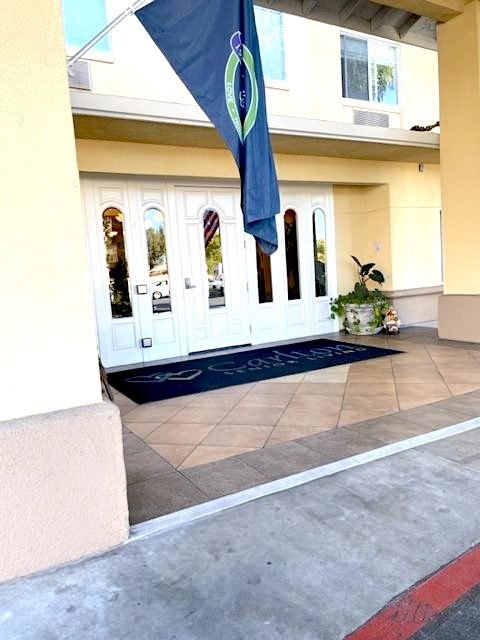
We had only been back home in Washington a few days when I got a frantic call from Peggy. There were blackouts from the heat, because that summer indeed was brutal in San Jose. She was really afraid—it was dark downstairs in her building’s main living room and she couldn’t see anything. I was able to ascertain that it wasn’t totally dark at her facility; they had generators providing some lighting. But it was a lot dimmer than Peggy was used to. I stayed on the phone with her for almost three hours, keeping her calm and keeping her company. Eventually she was able to get an escort to her room, and all was well again. Whew!
However, over the next several months Jon and I observed a slow and steady decline in Peggy. There was no single major incident, but a succession of minor ones. Like what happened in October: the beginning of her incontinence. I knew it was coming—we had seen harbingers of it a year earlier in Sicily—and now it was about to be happening for real.
“Tell me if this is an Alzheimer’s thing…,” Peggy said to me. I braced myself, because whenever she asked me that, it almost always was, and it was almost always bad. Today’s issue: She was starting to be afraid that she wouldn’t be able to make it to the bathroom in time.
I really didn’t want to bring up the issue of her needing to wear Depends, but I couldn’t put it off any longer. So I asked Peggy if I should get her some of the “other underwear” (the euphemism we’d been using for months). She was silent at first, then quietly said, “yes,” so I ordered the first packages of them for her. Then she wanted to know if this was “normal.” Well, nothing about Alzheimer’s is normal, per se, but incontinence is expected, so I told her, “yes, it’s normal.” She was relieved to hear this and, really, kind of pragmatic about it. I was impressed. I’m sure if it were me, I’d be a brat about the whole situation.
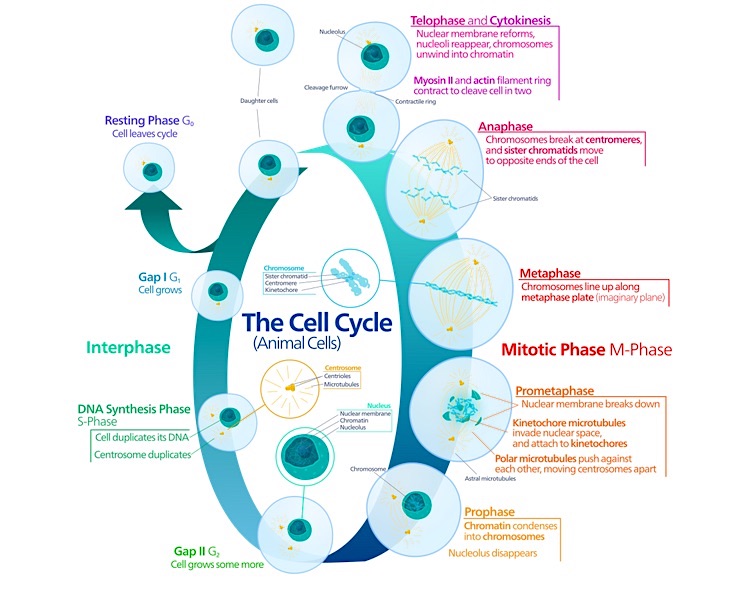
Whenever we would cross milestones like this, I would always think of cell division. (I know, I’m weird, but I studied biology in college, so humor me, okay?) In particular, I thought of mitosis and “interphase,” the so-called “quiescent” phase that makes up the daily life of a cell when it’s not replicating. In reality, things aren’t really quiescent; the cell is preparing for division, even if you aren’t able to see it. I think Alzheimer’s is just like that: everything seems to be in a “quiescent” phase, but the brain is changing daily on an incremental basis. At some point the damage becomes visible, whether it’s incontinence, aphasia progression, or something worse.
In mid-October another scary thing happened—well, scary for me, that is, while Peggy was pretty much unaware. We were talking on the phone for a while, and then out of the blue she said to me, “Okay, I’m back now.” What did that mean? Where was she before?
I was so alarmed by it that when I got off the phone I shut down the last of her credit cards and killed all of her remaining checks. That conversation was a big wake-up call for me that Peggy wasn’t as together as I wished she was. I didn’t want her to get tricked by someone on the phone, so I thought it best to cut off everything so scammers couldn’t reach her money.

That was a necessary decision, but a hard one. Even at the beginning of her Alzheimer’s journey, Peggy would tell me how much she wished she could be her old self, and live her life the way she had before. Largely because of those early conversations—and because some of her subscriptions for various services had been set to autopay—I had been keeping some of her credit cards open for her. I mostly kept them in my possession, monitored her accounts, and shut down anything suspicious. But I realized it was not enough. I had to remove all access.
I knew she wasn’t going to get any better, but it had been difficult to shut down another aspect of Peggy’s pre-dementia self. We all need bank accounts, credit cards, phones, and identification documents so that we can participate in the mechanics of living a productive life. Regrettably, that was all over for my sister at this point. We had already exchanged her driver’s license for a state ID, and I was keeping tight control over what apps were on her phone. So this was the final step.
In November, Peggy broke her earbuds again, the third pair in as many months. Good thing I had a zillion spares, since they used to come free with every iPhone, iPod, and other Apple electronics. I had put them in a box and never needed them, until Peggy. But before turning over yet another pair, this time we took a closer look—turns out her latest earbuds weren’t actually broken! Peggy had inadvertently turned the volume all the way down so no sound came out. Once we adjusted that, they worked perfectly. It all made so much more sense now.
In early December, the weirdest incident so far occurred. Peggy told me that she thought she sprained her ankle. I asked her if she was in pain and she said no. So I asked her to sit down and take off her shoes and socks and look to see if one of her ankles was swollen.
Much to my surprise Peggy responded, “Where’s my foot?” 😐
Fortunately, I didn’t freak out. I knew I had to keep my voice even, and under no circumstances could I let her know that her question was extremely weird and upsetting. So I asked her if she could put her hand on her knee. She was able to do that. I asked her to let her hand travel all the way down her leg, and told her that if she did that, she’d find her foot—which she did. Only after that were we able to determine that her ankle wasn’t swollen. Peggy showed no concern over this entire exchange, but inside, I had turned into a tight ball of stress.