
[TIMELINE: MARCH–APRIL 2021]
In March 2021, Peggy’s caregiver Liz—who had a lot of experience with people with dementia—told me that she thought my sister was probably nearing the end of Stage 5. My first reaction was: How can that be? It had only been a few years since she was diagnosed in 2018. But when Liz described why she came to that conclusion, I realized it was probably true.
For one thing (and this matched what I saw as well), Liz told me Peggy couldn’t always find her clothes in the closet. In fact, she couldn’t find a lot of things in her room. Her cat Jezebel was black and her dressers were all a dark brown, so Peggy couldn’t see Jezebel when she was sitting on top of the dresser in plain view. Liz and I also discussed how Peggy didn’t want the housekeepers at her facility to come in and clean for her, but I shut that down pronto!
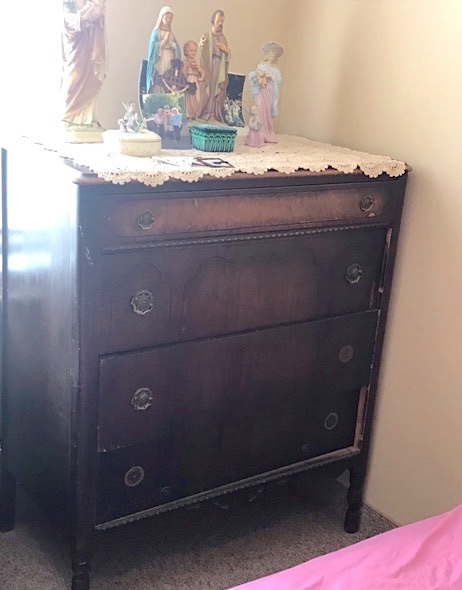
Peggy’s personal grooming had taken a hit at this time, which was painful to see, since all her life she had been meticulous in the way she presented herself. Back in the day, her hair and nails were always done (with toenails painted too), she always wore make-up and contact lenses instead of her glasses, and her clothes were always well-coordinated and stylish. Now, she wore the same clothes all the time—probably because she couldn’t really find anything in her closet or dressers. Make-up and contact lenses were things of the past.
I decided to add personal care services for Peggy, an option that her assisted living facility offers for people who are progressing in their illness. These special aides helped Peggy get dressed and made sure she had clean hair. And because there was a salon at her facility, she was able to have additional hair styling and get her nails done too, which made her happy.
One silver lining at this point was that my sister generally didn’t realize how steep her recent slide had been—and we didn’t tell her. It was anosognosia in action. Still, we noted amongst ourselves that her early-onset Alzheimer’s really was progressing as fast as they say it does. Even though not that much time had gone by, it was obvious she had taken a big cognition hit.

In April, there was a glitch with Peggy’s storage space, the one she’d kept since the early 1990s to save space in her condo (but hadn’t been to for years). Apparently, her credit card details didn’t transfer over to the company’s new computer system. Thanks to my power of attorney, I was able to get everything taken care of, but it raised a couple of ethical questions for me: When should I empty out that storage unit? What do I do with whatever is in there?
While I contemplated those issues, I added up the payments my sister had been making to the storage company every month. It was quite a bit. So I felt the time had come to empty it out—she’d probably never need whatever was in that space again. We really had no idea what stuff Peggy may have stashed away in there, but even if some of it turned out to be usable to her, she really didn’t have the mental capacity at this point to sort through any of it.
I knew she still cared about it all (or at least some part of her cared) because she periodically asked me about “her stuff.” I always assured her that everything was fine. But honestly, it was time. And of course, I felt extremely guilty for even considering it—but I had to do it.

A brief word about guilt. Guilt comes up a lot for caregivers. We feel guilty about everything, all the time. I discussed guilt with my therapist and with my forum mates on ALZConnected. Deep down, we all know we aren’t responsible for the situation our persons with dementia (PwDs) are in. We also all know that Alzheimer’s, or some related disease, is the responsible party.
I don’t know if there is a consensus on this, but when I discuss it with my circle, we acknowledge these feelings, and often realize that what we’re really feeling is sadness, regret, maybe anger at ourselves if we ever lost patience with our PwDs, as well as other emotions that may feel like guilt, but aren’t. It takes a while—maybe forever—to internalize this reality.
So I did my best to keep those feelings hidden from Peggy. I continued to call her nearly every day, but I would take either Saturday or Sunday off for myself. I needed to set aside at least one day a week to regroup and prepare for the week ahead. Because, to be honest, nearly every time I interacted with my sister it stressed me out to the same degree, even if there was no crisis pending. When your loved one has dementia, you are not in control, and that’s stressful! The only thing you can control is yourself. So it’s really important to keep some kind of balance in your life if you can do so, especially as your loved one’s dementia progresses.
Seriously: Try to go to the gym, take a walk, listen to music, have lunch with friends if you can manage it—anything that you can make time for that will help recharge you, and keep you connected to the world. Keeping yourself healthy and sane will help you be a good caregiver.

I tried to focus on the brief moments of lightness I experienced with Peggy. About a week after the storage credit card issue, I gave her a call—and actually got the sister I remembered on the phone! We had an almost normal conversation. She was having a good day and her mind was clear. It was so nice to talk to her without having to have my guard completely up.
Of course it didn’t last. The very next week, Peggy started looping again on wanting to go to Disneyland. I explained to her (okay, I bald-face lied to her) that Disneyland was still closed due to Covid and we couldn’t go there yet, but we’d go as soon as they opened. Covid was a useful Big Bad, since it was always a good excuse for why we couldn’t do the latest crazy thing that Peggy wanted to do. The long drive, the long lines to get on rides, the quest for bathrooms—just thinking about it makes me, again, figuratively break into hives, even now. Thankfully, Peggy was still practical about medical matters, and didn’t want to do anything unsafe.
Meanwhile, Peggy’s descriptions of staff, residents, and caregivers always kept me on my toes. Peggy would talk about “The Ladies” (I could always hear the capital letters when she said it), “The Girls,” and “The Little Girls.” It took me a while, but I eventually figured out who was who.
“The Ladies” were the housekeepers who cleaned Peggy’s room and did the laundry. In Peggy’s mind, “The Ladies” were evil and not to be trusted. “The Girls” were some of Peggy’s fellow female residents, even though none were younger than 70 years old! (I didn’t know what she called the men. Were they “The Boys”?) Then there were “The Little Girls.” That was the most difficult puzzle to crack. Peggy would say something like, “The Little Girls” came in today.” Who were we talking about here? Grandchildren of residents? Nope. Turns out that Peggy was referring to the facility’s caregivers and med techs who were all in their twenties. Okay, then.