
[TIMELINE: SEPTEMBER 2021]
As September got underway, I still didn’t have a time frame for when Peggy’s permanent move to memory care would happen, but I was sure it wasn’t far off—she was attending activities in that unit most days. Peggy actually had called to tell me all about it, and how she had been able to hang out with Ursula again. From my perspective, this was great news.
Mid-month, we both got a day that was a gift. I choose to believe it was an early birthday present from the universe to Peggy. She called to tell me that she was no longer afraid of memory care; apparently, her frequent visits had helped her to get used to it. She also told me how good of a time she had doing the day’s activities there with Ursula. I think a big part of her changed attitude was that she could see how well Ursula was doing.
These are the moments I savored. Once your loved one is knocking on memory care’s door, there are still good moments to be had, but they become much more infrequent, and a lot of times it’s up to you as a caregiver to make those good moments happen.
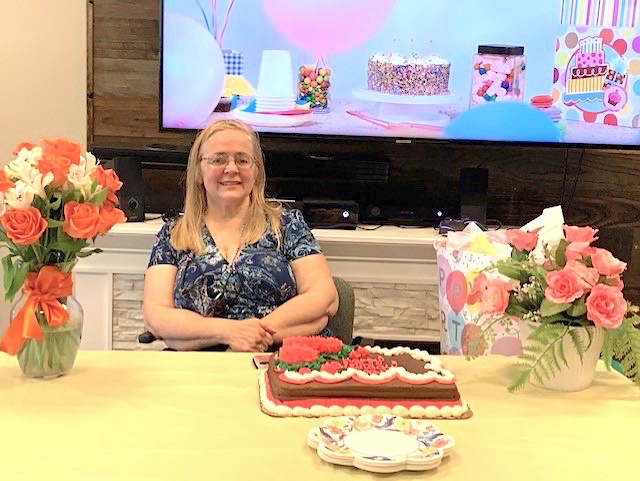
Later on that same week, Peggy called me again to tell me about her day of activities in memory care, and she confirmed that she was still okay with it. Ursula continued to be an anchor for Peggy. I was happy my sister found a friendly face there even before her move.
Meanwhile, I continued to get support from my forum mates on ALZConnected, from my therapist Katy, and from all the different members of “Team Peggy” that we had assembled.
After my next in-person visit with my sister and some meetings with the assisted living staff, I updated Katy on all of the changes happening, and shared that Peggy’s move to memory care seemed imminent. She suggested that now might be a good time to take away Peggy’s phone. I was reluctant to do that, but I told her I’d consider it. I also told Katy about Peggy’s latest challenge: the shower had become a source of stress for her.
When people with dementia (PwD) get to the later stages of their disease, the shower can become a mysterious place for them—familiar, yet confusing. How do you “take” a shower? How do you turn the water on? Off? What is the proper order of everything you’re supposed to do? When do you use a towel? Before, after, or during? How do you regulate the temperature of the water? There’s so many questions—and, if you have dementia, so few answers.
What PwDs often end up doing is skip taking a shower entirely, and they’ll often fight you if you try to help. It’s all just too hard for them, and too uncomfortable. Peggy was already at the stage where she couldn’t wash her hair any longer, so she just skipped it. Her hair was still fairly long at this point, so leaving it dirty was not something she could hide.
For my sister, the biggest problem was the ordering of tasks. A normal shower order would be (obviously): start running the water, wait until it’s at a comfortable temperature, step in, soap up, rinse off, lather your hair, rinse off, turn off the water, dry off. But Peggy might run the water, dry off, and then try to soap up. And washing her hair was no longer in the mix at all.
I knew what Peggy’s problems with the shower were because she told me directly–mostly she said she was uncomfortable in there. I marveled that she could communicate that thought to me at all, since most people at her stage of dementia couldn’t. I asked her a lot of yes-or-no questions to help me really pinpoint the problems. It turned out that she couldn’t figure out how to regulate the water temperature anymore, and that contributed to her discomfort. My therapist said to follow the staff’s lead on this, which I did. Katy also agreed with me that it was apparent Peggy’s move to memory care would happen sooner rather than later.
At least the facility’s staff were still taking great care of Peggy’s kitty cat, Chloe, so I was never worried about food and water for her. One time I asked Peggy if she knew the name of the staffer who usually took care of Chloe, and that turned into a fun little exchange:
Peggy: It’s Ef, Ef…
Me: Efrem?
Peggy: Yes, it’s Efrem!
Me: Just like Efrem Zimbalist Jr.?
Peggy: [laughs]
She laughed! And I laughed with her. She got my joke! Efrem Zimbalist Jr. for the win!
Peggy actually remembered the ’60s/’70s TV show, The F.B.I.—that my dad watched every week and that we, as kids, couldn’t help but absorb—and its overly dramatic, triumphant intro music and voiceover: “Da-da-da-dun, da-da-da-dun…the EFF BEE EYE…starring EFREM ZIMBALIST JUNIOR….” It was a great moment for me to connect with my sister this way. If you’re of a certain age, you probably remember this show, too—and if so, I hope you’re smiling right about now.

Also around this time, Peggy told me that she’d been talking to her friend Angelique, who she had known since kindergarten. I didn’t know that they were still in touch, so this was great to hear.
My memory of Angelique was of a little 8-year-old girl with dark brown hair in braids; I think that was the last time I interacted with her in person. I figured that I should try to get in touch with her myself to reconnect, and eventually I was able to reach her by phone.
It turned out that Angelique had much more insight into Peggy and how she was doing than many. I was thrilled to be in contact with her. On our first phone call we talked for hours, sharing information about Peggy and getting to know each other as adults. She remarked to me that I sounded like my sister, “except clear.” I’ve been told more times than I can count that Peggy and I sounded exactly the same on the phone—even my mother couldn’t tell us apart.
With Angelique now in the loop with me and Michael, I thought how lucky we were to be adding yet another wonderful member to “Team Peggy.” Frankly, it was just in time, because we had another disconcerting event in store before the month wrapped up.
Towards the end of September, Peggy called me, frantic. She couldn’t find the shower—and she couldn’t even find the bathroom! As I’ve mentioned, her assisted living apartment had a very open floor plan and it was small, less than a thousand square feet. Once you were inside, you could see nearly the whole apartment from the front door. You couldn’t see the bathroom, but you could easily spot the microscopically short hall that led to its door.
I couldn’t let Peggy know how distressed I was to hear this from her. I made sure to keep my voice calm and encouraging, and gave her step-by-step directions to get to the bathroom. Thankfully, she was able to follow what I saying to her this time. She found the bathroom and walked inside—and then she saw the shower. She exclaimed, “there’s all my stuff!”
When I heard that, my heart sank. Honestly, my first thought was: Seriously, kill me now. One of the absolute hardest things about Peggy’s dementia for me was always having to pretend that everything was okay, especially when everything was so very clearly not.