
[TIMELINE: JULY 2021]
Later in July, my partner and I visited Peggy and picked up Jezebel’s ashes for her on the way. They’re in a pretty little resin container with an imprint of one of her paws on the top. We set it on Peggy’s dresser, and Liz placed Jezebel’s collar on top. It looked almost like a little shrine. My sister loved it, so I’m glad we took the extra effort to get Jezebel cremated.
While I was in town, I made sure to enroll Peggy’s other cat, Chloe, into her assisted living facility’s pet care program. That would ensure dedicated staff would come by a couple of times a day to feed Chloe, make sure she had fresh water, and clean out her cat box.
Once I got the kitty situation resolved, I could focus a bit more on what was going on with Peggy. Looking back, I remember the biggest change I noticed at the time was that Peggy’s mind was still not where it used to be. Her fall and head injury changed things, and she never returned to her previous baseline. This became another new normal for us.
Peggy spent most of the month in good humor, but her speech was now filled with word salad; the words she used were in English, but they seemed randomly strung together.
Even though her speech made no sense to me and I had no idea what she meant, I could tell by her facial expressions and voice intonations that she thought her sentences were coherent and intelligible. I ended up just agreeing with whatever she told me and hoped for the best. Many nouns were a thing of the past for Peggy at this point, so I would play word association with her to figure out even a hint as to what she was talking about. Needless to say, I kept my detective efforts as sub rosa as possible so as not to upset her.
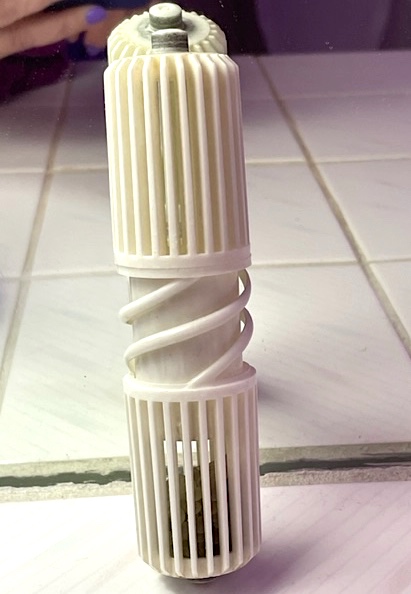
Here’s a typical exchange. One day, she asked me to solve a problem she was having with the “white thing like the parents had.” I had no idea what she was talking about, but the issue seemed to be urgent. After many guesses (where I asked about shape, size, which room the thing should be used in, etc.), the “white thing” turned out to be her bathroom’s toilet paper holder, and the problem was that she couldn’t figure out how to get the fresh roll of toilet paper onto it. Since I wasn’t there in person, I needed to request a staff member go to her apartment and do it for her. Problem solved, and potentially a really messy disaster averted.
Yet in spite of incidents like that, I kept trying to talk myself into believing that things weren’t as bad as they were. But in reality—yeah, things were that bad, and I really did know it. When I look back at the situation, I laugh at myself for thinking that memory care was still at least a year away for Peggy. At that point in time, memory care was only a few months out.
A lot of PwDs in the mid-to-later stages are drifting away from reality; they don’t really know that their behavior could be a problem (see anosognosia). But Peggy’s memory actually stayed with her for a long time during her illness. I think it’s because frontotemporal dementia (FTD) can present really differently than Alzheimer’s. So sometimes, my sister was still aware that things had changed for her, even though she was at a loss for what to do about it.
Then there were other times when Peggy was more disconnected. For example, she would tell me she had a good day, even though staff and caregivers had told me she had a bad day.
I was glad she thought everything was fine—at least she wasn’t sad—but it definitely wasn’t a good sign that she was getting to the point where her bad episodes didn’t register.
Late in July, I got a call from Desiree, one of Peggy’s two outside caregivers that visited her in the facility. She told me that Peggy’s apartment was in disarray, particularly the bathroom. Apparently, Peggy had missed the toilet, tried to clean it up, and only managed to make it more gross. Desiree took care of it for her. Cleaning up after accidents—which can occur in the bathroom or, more distressingly, not in the bathroom—becomes a big part of a caregiver’s life.
This incident totally stressed Peggy out, but at least the staff was there to help calm her down. She was really upset in that moment, but she completely forgot about it later on. When I spoke with her on the phone a few hours later, she told me she had a good day.
Peggy’s word salad became worse if she got stressed. The day after the bathroom incident, Peggy called me, quite worried. She said she wasn’t sure if she fed Chloe or had given her water. I called the front desk, and asked if they’d go to her room and check, which they did. I stayed on the phone with Peggy because she was so upset. Then her worry changed to anger, and she became furious at “The Ladies,” the ones who came in to check on Chloe.
Peggy thought they were there to take Chloe away from her. I assured her that wouldn’t happen. What ensued next was a lot of word salad “discussion” that I won’t even pretend that I understood. Her speech was so bad that when I finally got off the phone, all I could do was sit there for a moment soaking in the wonderment of that “conversation.” Aside from the few parts about Chloe, I couldn’t tell you what that call was about if my life depended on it.
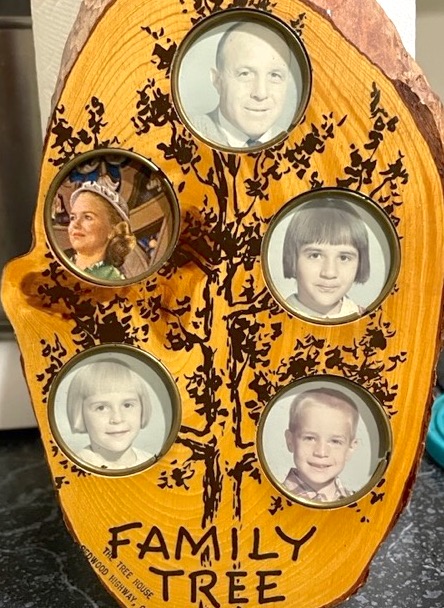
Another time, Peggy phoned me about a special family photo—except her speech was so garbled that I was about twenty minutes into the call before I realized even remotely what we were talking about. Peggy tried to describe it for me. The best I could understand was that it was a well-known family photo taken when we were children, and that I would recognize it if I saw it. I tried to find out if it was in a frame, and if it was a large photo or a small one. No dice.
She told me she was going to put the photo in her closet (but then had to ask me where her closet was). Then she decided she would hang it. A few minutes later, she told me she couldn’t find the photo, and I suggested it might be in her closet; round and round the conversation went. And somehow, Peggy managed to weave a host of other topics all through this entire saga—such as how good Liz was to her that day, her annoyance at “The Ladies,” and of course, Chloe.
This was a half-hour phone call filled with so many topics that they pretty much bounced off the walls and wound up somewhere outside. They certainly didn’t land anywhere near me where I could grasp them. To put it another way: It felt like our conversation was a crazy game of tennis, but we were each playing on a different court! It was all just so bizarre. It sounds a bit funny now, but at the time I was so exasperated. Peggy had no idea how garbled her speech really was. Her words (and maybe her thought processes) were disordered and disjointed. I had no idea if I was witnessing a natural progression of her disease, or some new issue to worry about.
One worry for caregivers of PwDs is that a sudden difference in behavior—like extra word salad, or bathroom incidents—could mean a new physical health issue, such as a urinary tract infection. Fortunately, we were able to rule that out this time. Unfortunately, that meant that my sister’s deterioration was just her Alzheimer’s progressing even more quickly than before.
On my next in-person visit, Peggy and I found in her closet the small “family photo” that she had tried to speak to me about weeks earlier. I did, indeed, recognize it!
This weird photo collage frame made out of slab of a tree, which used to hang in our parents’ house, was always a source of amusement between us. The beloved frame held cute portraits of us kids when we were young, plus one of my dad—but for some reason our mom had never put in her own. Instead, a stock photo of a model (or perhaps Princess Grace?) was there in our mother’s place. We never had a clue as to why, but we always laughed about it.