
[TIMELINE: March 2023]
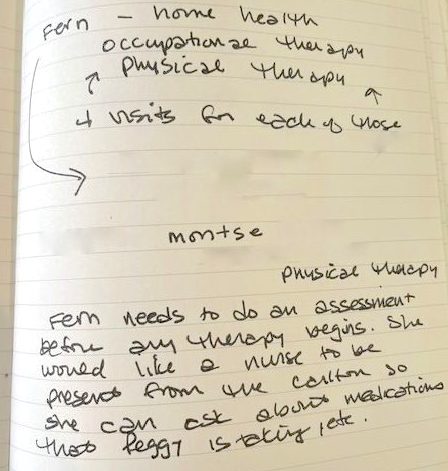
After my call with Peggy’s psychiatrist Dr. Phan, I was contacted by Fern, the registered nurse (RN) from Kaiser who would be working with Peggy throughout March. Fern explained that her first steps would be an overall assessment of Peggy, alongside meetings with the other RNs in memory care. Yet even though she wouldn’t be seeing Peggy for another week-plus, I already felt relieved. In fact, in my notes from the day of our call, I can see that I wrote, “I love her already!”
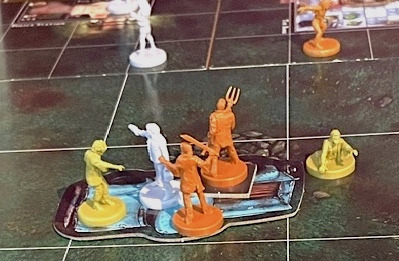
Fern’s concrete planning for Peggy made me feel like she was truly the adult in the room. Not that the staff at my sister’s facility weren’t competent; they were, and they were always so helpful and caring. But Fern swooping in and shaking things up made a big impact on me. If I were trapped in a zombie movie or game—in my most desperate, darkest hour, with the monsters about to overwhelm me and turn me into one of the living dead—it was Fern who arrived with reinforcements. A great feeling of relief came over me that very first time I spoke with her.
Fern also made a big impact on Peggy. She came to see her in memory care once or twice a week for more than a month, and really took charge of Peggy’s living situation. At every visit, she would check Peggy’s vitals, review her needs, and talk to staff on her behalf. Best of all, she made sure the staff were up to speed on how to best care for Peggy given the unique progression of her diseases, which included both frontotemporal dementia (FTD) and early-onset Alzheimer’s.
In many ways, FTD is a different beast than Alzheimer’s, so more education about it was always welcome. Not that the memory care staff didn’t know what to do, but I think Fern was able to give them a few new techniques for handling Peggy. And here’s something sweet: Not only did my sister totally trust her, but she was so completely charmed by Fern’s name that she would comply with any of her directives. (Hey, whatever works, right?)
Fern was so no-nonsense and so competent. She radiated confidence and skill, and she always had answers for me in our numerous phone conversations. I was sorry I never got the chance to meet her in person. I really liked her! I wished she could be part of “Team Peggy” forever. Alas, Fern’s time with Peggy had to come to an end, and soon she filed her final report with Kaiser. I was sad when she was done! But I will always be grateful to her for the many small changes to Peggy’s care that she set in motion, and the expertise she shared with me and the staff.
For the next few weeks, the plans we had begun implementing helped contribute to a bit of a lull from all the chaos of February, as we continually sought improvements to Peggy’s quality of life. Dr. Phan had changed up her medications, we had arranged for imminent on-site appointments with a physical therapist and occupational therapist, and Kaiser had just approved Peggy’s new hospital bed with half-rails. So there was less screaming and fewer falls, more experts were on their way, and the costs were being covered. These developments added to my feeling of relief. I wouldn’t call it a plateau, but I felt that at least things weren’t getting any worse. It gave me a bit of time to catch my breath and regroup. Of course, that didn’t mean all was smooth sailing. It wasn’t.
For one thing, Peggy still hallucinated Uncle Nick, which bothered her because she knew he was dead. Caregiver Liz revealed that she even witnessed Peggy “telling” Uncle Nick out loud to go away. It must have been disconcerting for Liz to hear that one-sided conversation! That same night, Peggy’s lifelong friend Dodie called in to memory care to speak to her, but staff told her that Peggy was in her room crying and wouldn’t come out—not even for Dodie.
So I tried getting through to my sister, but it was the same deal. Peggy was crying and wouldn’t come to the landline phone. Thankfully, staff called me back using one of the memory care iPads, which they took to Peggy in her room. She agreed to talk to me, and I was able to finally calm her down. By the time we were finished speaking, I had even managed to get her to laugh a few times. I was happy to help, but also a little bit distressed. It was getting so much harder to break through Peggy’s emotional spirals once she was caught in one, even for me.
On a hunch, I wondered if Peggy was in such a bad state on this night because she was hungry. I had just learned from staff a few weeks prior that she had started to skip meals now and then, so that was in the back of my mind. I asked her if she had eaten recently, and sure enough she hadn’t. Peggy skipping meals was not a good sign. We were quite a ways away still from the expected downward spiral of Stage 7 dementia, but I knew her not wanting to eat could be the beginning. I feared that in six months, Peggy was going to be much thinner.

So as soon as I hung up with Peggy, I called memory care back to see if they could get her a snack. I was glad to learn that they were already in the process of doing so. They were on it.
Another ongoing issue with Peggy is that she believed that everyone kept “taking her stuff” and it made her upset. She had told me that her room was empty, which I knew of course it was not. I told her I’d talk about it with Brandee, the new memory care director, and that seemed to satisfy her for the moment. Fortunately, Michael visited her the next day. Although he said she seemed more “fragile” than before, more careful and unsure of her space, he still got her to smile and laugh, so that was positive to hear. With dementia, you take the wins where you can.
To further these wins, members of Team Peggy brainstormed a few additional ways to keep up her spirits. Michael, Sue, and I conspired to make sure that Peggy always had access to her beloved chocolate. The three of us constantly brought her provisions: Godiva from Michael, dark chocolate/marzipan Ritter Sport from Sue, and Sees Candies from me. We even set aside a hidden drawer in her room to stow our stash of “emergency” chocolate. Peggy would always light up when we brought out some of these delicacies and offered them to her during our visits.

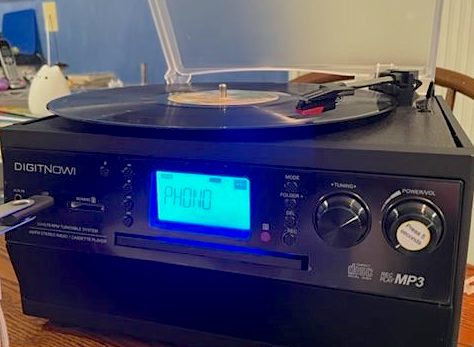
Around this time, I also got in touch with my inner DJ! Since Peggy enjoyed listening to music so much, I started to make her “mixtapes.” Well, mixed CDs really. For months now, I had been moving Peggy’s vinyl collection to CDs, because that was the technology available in her room. My partner and I had found a converter to do the trick. It is actually an ingenious little record player that creates an MP3 file out of a vinyl album at the same time as you’re playing it. I’d then burn those audio files onto CDs. I converted some full-length albums, like Fleetwood Mac, but I also created mixes of other Peggy’s favorites, including Duran Duran, Madonna, and Cyndi Lauper.
As handy as the technology was to have, I’ll just add that it was so persnickety. If the stars didn’t align exactly, you could play one side of an album as directed but still get no MP3 file. Then you have to make another attempt, and then another, until finally it works. How many times did I listen to that *^$%^#*% Fleetwood Mac album, Rumours, to convert it to CD for Peggy? More than I can count! But it was Peggy’s favorite album by her favorite band, so failure was not an option. As much as Peggy loved the mixes I made for her, they were nothing compared to that album!
Throughout this process, my partner Jon and I were left feeling a bit old and not “technologically able” about things—at least until our nephew assured us that everybody has problems with those finicky devices, even musicians and tech whizzes like him. Yay! It wasn’t just us.
So yeah, the process was ultimately a bit of a hassle, but it was so worth it for improving Peggy’s mood on a daily basis. We listened to music together in her room whenever I visited, and she enjoyed it on her own, too. The bonus to having music available at the ready for staff? It was a great motivator to keep Peggy on routine, according to Rebecca, who coordinated activities in memory care. She said music really helped every morning when they would get Peggy dressed!
Later in the month, after Fern conducted her first in-person assessment and we had succeeded in scheduling upcoming visits from the additional therapists, I indulged in a little self-care by attending two nights celebrating the 30th Anniversary of our favorite San Francisco club night, Death Guild at DNA Lounge, on March 13 and March 20. It was an easy decision to add these events into our schedule since I already planned to be in California at the same time for some of Peggy’s appointments, and to help my aunt and cousins prepare for my Uncle Nick’s funeral.
Honestly, by the time these DG anniversary celebrations came around I was so ready to dance for hours and not stop, to get some of my frustrations out of my system! And in hindsight, it was a really good thing that I took the opportunity. It was the boost I needed to face the scary news I got just a few days later, when I took Peggy for a neurology appointment on orders from Dr. Phan. The neurologist prescribed some new medications that we hoped would help with Peggy’s tremors and jerkiness, but the visit really drove home to me just how bad things had been getting.

I mean, I knew Peggy’s condition had deteriorated quite a bit, but part of me always held out some irrational hope that the situation might not in actuality be as bad as I thought it was. Deep down, yes, I knew it was probably that bad. But it wasn’t until I witnessed so many of her difficulties up close that it all felt so real. She failed just about every cognitive test the neurologist gave her. She didn’t know what the date was, or even which day of the week. She was unable to identify a pen or what it was used for. She couldn’t follow simple directions. She didn’t understand what the doctor wanted when he asked her to move her legs up and down. It was inescapably real.
Afterwards, Peggy asked me how I thought everything went with her appointment—and I told her things were fine. “You did great,” I said, just trying to hold myself together. Her reply? “I’m trying!”