
[TIMELINE: September 2023]
As September progressed—and so did my sister’s Alzheimer’s—Peggy’s best friend Michael and I continued to compare notes. We were tracking Peggy’s moods and behaviors closely, to better understand the stages of her disease and where she was at, according to those metrics.
It wasn’t always easy to figure out everything, since Peggy had frontotemporal dementia (FTD) as well as early-onset Alzheimer’s. But I found some really useful information from gerontologist Tam Cummings, PhD, which I shared with Michael. For example, Cummings offers a number of free assessment tools on her website, including a Dementia Behavioral Assessment Tool [PDF], which details which types of dementia affect which parts of the brain, and what kinds of behaviors one can expect to see at each stage. She also has a specialized FTD Assessment Tool [PDF].
Based on what Michael and I had observed, I believed Peggy was in late Stage 6 but not quite in Stage 7 yet. The only issue Peggy was dealing with on the latter list so far was the inability to walk without assistance. I considered this a good sign, relatively speaking.
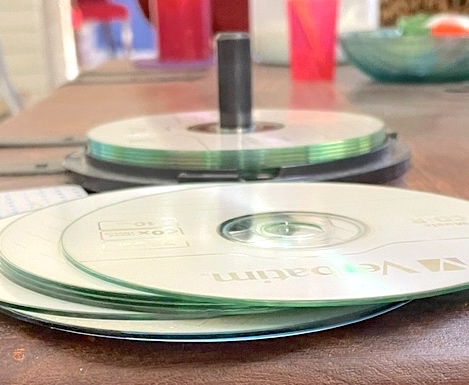
Another positive development was that things had been somewhat calmer ever since Peggy’s doctor increased her trazodone doze to the maximum. So lots of trazodone was now in the mix. I also continued to burn CDs of Peggy’s favorite (mostly ’80s) music, so she had an ongoing fresh supply of tunes to play in her room. That definitely helped her mood. Yay, Madonna!
Not everything was smooth sailing, of course. Peggy still had outbursts, and she still argued with The Lady—her most recurring, scary hallucination. But for a while, Peggy had no more extended bouts of screaming, and we had continued success with Michael’s creative tactic of playing along that The Lady was real. As long as we also reminded Peggy that The Lady was a big liar and we shouldn’t listen to anything “she” said, it became a lot easier to redirect her.
When I told my therapist Katy about this strategy at our next visit mid-month, she confirmed that it was a clever approach to the situation. That gave me a little boost.
Around the same time, Peggy was experiencing a high spot of her own—her birthday! I was coming to visit her in less than a week, but first she got to enjoy a little celebration on her actual birthday, courtesy of the memory care staff. They put me on FaceTime with her while they sang “Happy Birthday,” then helped facilitate additional calls for her. First, her oldest friend Dodie phoned, then Peggy got to speak with numerous other friends and family members. When I talked to her again later in the day, she sounded so happy. She didn’t mention The Lady or any other hallucination. For those moments, she was free of them all. I was so glad she had a great day!
Three days later, on what would have been our mom’s birthday, I called Peggy again. And to my delight, she brought up Mom in conversation, even though she didn’t remember the date. Michael and I agreed that Peggy, somehow, subconsciously knew what day it was. Wild, right?
So the call turned out great, even though I had worried about it at the start of our conversation since she seemed on edge, and anxious to know when I would be visiting next. But all she needed to know was that we would be driving down the next day and her mood improved immediately. Then I mentioned all of the cool friends and family she had in her life—Michael, Dodie, Les, Aunt Betty, our cousins, and so on, and she loved that. It made her happy to think about everyone.
The next day began a week of super socializing for Peggy. My partner Jon and I were able to come down to the San Jose area for an entire week, and visited Peggy every single day. Michael also visited her that week as usual, on Monday, Wednesday, Friday, and Sunday. Between us, Peggy had company every day, for almost the whole day. I think that really made things special for her. We scheduled it so Michael came by late mornings, while I visited in the afternoons.
Michael and I only overlapped a little bit, but we still got to spend time some quality together because Jon and I stayed with him for a couple of days mid-week during our trip. It was a wonderful opportunity for us to get to know each other better, and to talk about Peggy.
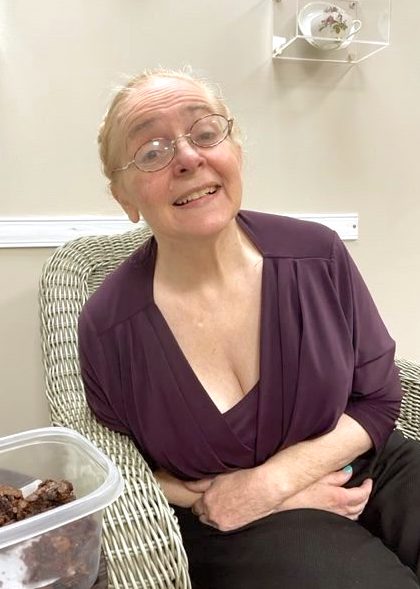
Unsurprisingly, Peggy was in fairly good humor the entire week, and the brownies I brought certainly helped. It was the perfect treat for her because she loved chocolate, plus it was an easy finger food for her to handle. I had some experience with finger foods already; there were multiple occasions during recent visits that I stayed with her through meals and helped her with them.
I have to say that I’m still kind of impressed with how staff at the Carlton usually planned out their finger foods for memory care residents. The choices were always tasty, with portions that are easy to just pick up and eat with your hands—like strips of chicken, prawns, and smaller pieces of carrots and potatoes. Sometimes I needed to cut it into smaller pieces for her, no big deal.
However, Peggy had now reached a kind of crossroads: finger food, or hand feeding? Whoa. That was new territory for me. I was used to helping Peggy during meals, but I won’t lie—the idea of hand feeding weirded me out. So I tried to use this visit to adjust into this potential new reality.
We started out with finger foods as usual, but I knew when that became too difficult for her, then I would have to get used to hand feeding. Thankfully, Peggy never thought it was weird; and as long as she was okay with us helping her in that way, that was the most important thing.
Still, a meal with Peggy could be a surreal experience for other reasons, too. I was glad to see that her appetite was still pretty good, but she didn’t always recognize food as food anymore. She would sometimes query, “and this one?” while pointing to her next bite of a carrot or a prawn. I’d say to her, “You go ahead and eat it,” and sometimes she would, with no issues. But other times, she would try to pick up the plate and eat that instead. All we could do was redirect her, and hope we could convince her to finish enough at each meal that she would get the nutrients she needed.
Despite the efforts of the professional memory care staff and all of us on Team Peggy, though, I know she had lost more weight since my previous visit.
Peggy’s poor balance due to her Pisa syndrome was also a worsening issue, so she would hover in between being able to walk short distances (with assistance) and needing to use her transport wheelchair. It all depended on how she felt on any given day; sometimes walking was in the cards, sometimes not. When I was the one walking with her, like during this visit, I made sure to be in a good position to catch her if she started to slip—and I would marvel, again at how imperative my gym training had become to my role as a caregiver. I wonder if Michael felt the same way?
At least she was in good hands when neither I nor Michael could be there with her, or Liz or Desiree (the supplemental caregivers I hired for Peggy). The danger of her tipping over or falling was just too great, so memory care staff would always step in to make sure she was never alone.
Peggy’s cognitive deficits were obvious, too. In the few months prior to this visit, I could already see that she had begun existing in her own reality a lot of the time, and that was even more the case when I saw her again in September. It’s hard to explain, but I was struck then by the feeling that, even though there was still a lot of Peggy inside her, she was no longer all there.
I noticed that Peggy often would get a blank look on her face, just completely blank, and that was unsettling. I don’t know where she went when she was in that blank state, but she didn’t seem to be with me, if you know what I mean. But she didn’t seem upset either before or after this happened; I don’t think she even realized she was doing it. One time she even looked right at me afterwards and smiled, and it was clear she knew exactly who I was. I took comfort in that.
I also took comfort in the fact that she still recognized all of us. Sure, sometimes when she’d address me by name, she would use a triumphant tone that seemed to say, “See? I got your name right!” And sometimes, she kept referring to me in the third person even when I was sitting right next to her, which I never got used to. But I know, deep down, she still knew who we were.
On the other hand, there were also times Peggy looked around the room or space she was in and I could tell that she had no idea where she was. Mostly this occurred when she was seated in one of the gray wicker chairs in the front lobby area; though she didn’t say anything directly to me about it, it was obvious from the panicky expression on her face what was happening.

At first, I just mentally added it to the long list of all of the new and strange behaviors Peggy had exhibited in recent months, knowing that it was just another manifestation of the forward progression of her disease. Nothing good, but nothing too concerning. Except each time this happened during my visit, Peggy got really upset, and that did concern me.
I had mostly made peace with the fact that Peggy was becoming more and more “unaware of her surroundings,” as caregiver Desiree explained it to me, because that’s the reality of dementia and what it does to a person. There was nothing any of us could do about that. But I never wanted my sister to be distressed, either, and I did everything I could do to make her feel secure and safe. So it was a relief to me that whenever she got disoriented and upset, she seemed to get her bearings again eventually, and she would relax and all would be well again.
But I have a confession to make, too. As much as I cared so deeply about daily Peggy’s wellbeing, there was one terrible moment during my visit that I regret. In fact, I still cringe over it. I had been doing so well in navigating her ever-shifting moods and feelings; I schooled my facial expressions, I spoke in a soothing or upbeat tone of voice, I never yelled at her, and I even limited my wardrobe to a few bright or pastel pieces, instead of my usual black clothing. But then—failure.
Since the Covid pandemic was still going strong during this time period, I always wore a colorful mask when visiting memory care. By 2023, it was always the same bright paisley pattern called Candide, which was Peggy’s favorite. Then I ran out of those, and when we reordered I accidentally got a different pattern, the blue-green Chakra. I should have known better! When I wore the Chakra mask into memory care, Peggy was so, so confused by it. She kept pointing at my face and asking, “Is this you? Is this you?” She hated it, and was mightily distressed.
Not for the first time, kill me now kill me now began running through my head. Peggy had been having a perfectly lovely day, and I ruined it by being careless. I had to keep front of mind from now on that her deficits were piling up, and she was extremely sensitive to changes in routine.
So I put in a rush order for new Candide masks that very night, and the next day wore a plain white N95 mask to visit Peggy. That went over much better, although she still commented on it. It was better than the blue one, I guess, but still unexpected—it seemed that if my mask was any other color or pattern than the one Peggy was used to, it made my face look too different and that was jarring for her. Apparently, Candide paisley had become part of my identity!