
[TIMELINE: March–April 2023]
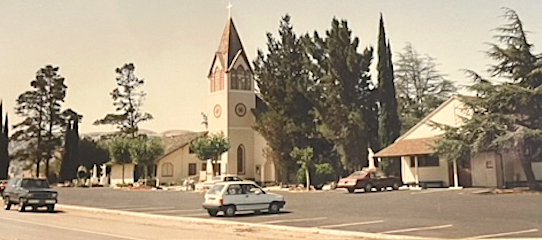
During the second half of March, shortly after her neurology exam, my sister was evaluated by both a physical therapist and an occupational therapist, whose first appointments with her were within days of each other. I was overjoyed that Kaiser approved multiple sessions with each at the Carlton, so Peggy would not have to travel outside of her facility for any appointments.
Peggy’s doctor had specifically recommended physical therapy since she had fallen a few times recently due to her Parkinson’s Pisa syndrome, which meant she now leaned to one side when sitting or standing. And if someone didn’t hold onto her when she was walking, she would tip over. Peggy also leaned far backwards sometimes, which elevated her fall risk even further. So we hoped there were some ways to improve her declining balance, coordination, and strength, and Montse came several times to memory care to work on those issues with Peggy.
I was there for the first of Montse’s physical therapy visits, which included various exercises and activities. I remember one coordination exercise in which she asked Peggy to throw a beanbag into a bucket about five feet away from her. Peggy couldn’t do it, of course, but Montse worked hard to keep her motivated. She even had me try it, too. Then our eyes met, and I knew she wanted me to miss the bucket so as to not make Peggy feel bad. So I purposefully missed!
I appreciated the skill and sensitivity with which Montse navigated things that first day, so I knew Peggy would be in good hands with her going forward.

Tammy, the occupational therapist, similarly impressed me when I met her, plus she was lively and fun. One of her first tasks was assessing Peggy’s vocabulary and speaking abilities, which she did through music. So there we all were, singing Duran Duran together! Thanks to my MP3 converter, they were just one of many bands from Peggy’s original vinyl collection that she now could play in her room. They’re also one of my favorites—but who doesn’t love a little Duran Duran?
A key area of concern for Tammy was observing Peggy as she attempted to navigate her day-to-day routines, and determining what adaptations could be made to make things a little easier and safer for her. Did Peggy need any other equipment beyond the hospital bed with half rails that Kaiser had already approved? What about a walker? Actually, Kaiser had already approved one, should Peggy need it, but I had waited to consult with Tammy before I put in a request.
Tammy was completely honest with me, and I trusted her judgement. She did not recommend walkers for her patients. “I call them trippers,” she joked, explaining that a person with dementia and mobility issues will typically put their full weight on a walker, and then just fall right down.
So that was off the table. Tammy suggested, instead, that we walk with Peggy—someone on either side of her, each taking an arm—and procure for her a narrow transport (push) wheelchair as well. That way, Peggy would be safe if she wanted to walk, because we would be there to catch her if she started to slip, but if she wasn’t up to walking, she’d have the wheelchair as an option.
Peggy’s time with Montse and Tammy came to an end after a month or so of weekly visits. Then both therapists wrote up their final reports as is customary, although the report from Fern, the RN in charge of Peggy’s case for Kaiser, was obviously the most impactful. I know Peggy appreciated their care—as did I—even though they were limited in what they could accomplish with Peggy since her Alzheimer’s was so advanced. But that wasn’t their fault, obviously. In hindsight, I see March 2023 was a watershed: It was the beginning of the last year of Peggy’s life.
The same week of Peggy’s first visits with Montse and Tammy, the rest of the family all went to Uncle Nick’s funeral. Fortunately, nobody told Peggy about it—and I was really happy about that. After my uncle’s mass there was a memorial lunch, at which I sucked it up and talked to Les in person. I was following the guidance of my therapist Katy, even though my first instinct was to ignore him as long as I could. I very much wanted to avoid any friction or raised voices around so much of our family. I was still so angry with him for his disruptions to Peggy’s routine, his blurting out bad news to her, and his unwillingness to coordinate or cooperate with me in any way.
But I knew our sister really wanted to see him, so I pulled him aside to tell him just that. I also let him know that it hurt her feelings that he didn’t stop by the Carlton more often. I knew this was the case because she would always make excuses for him when I asked her if she had seen him. “Oh, I know he’s busy,” she would say, but it was clear that not seeing him really made her sad.
I also told him again: Please do not give Peggy any bad news about anything, anywhere in the world. If there is a fire in Finland, don’t mention it. An earthquake in Indonesia? It didn’t happen. Has any person Peggy’s ever known, or even heard of, gotten sick or died? Nope, they’re all healthy and immortal. It was a tense exchange, but for some reason, I felt he was receptive to my concerns. I was cautiously optimistic then that he would do the right thing this time.
Another moment that boosted my mood was hearing later how our conversation looked from the outside. As Les and I talked, our cousin Michelle and my partner Jon had been huddled in a corner, surreptitiously stealing glances at us the entire time. Afterwards, they told me that they were watching to see if fireworks—or even fisticuffs—were going to break out. Can you imagine? I had to laugh at the fun image that put in my mind, very soap opera. But no, that was never going to happen at Uncle Nick’s memorial. Les and I were both on our very best behavior.
I closed out the month of March by scheduling another session with Katy. I had a lot to talk about, and she usually offered me good advice and a fresh perspective on everything. As always, I updated her on what had been happening, including what transpired during my recent visits with Peggy. I told her about Peggy’s sudden outbursts, the awful prognosis from her neurologist, her recent falls, the shuffling gait that Montse and Tammy were trying to help. We discussed it all. I was really hoping she had advice for me, some concrete suggestions for how to proceed that I hadn’t thought of yet. Alas, this time around, Katy was more focused on giving me perspective.
This disease was going to go the way it was going to go, she reminded me. I just had to accept it and do whatever I could do support my sister. In a way, I thought it was kind of funny. So you’re telling me I just need to suck it up some more? Sure, I could do that.
And Katy was absolutely right. By the beginning of April, we faced another milestone as Peggy began eating only finger foods. We could all see it coming; sometimes recently she would pick up a knife instead of a spoon to eat soup. Or she would look at the silverware before her on the table, and it was clear they had all become mystery objects to her.
Still, the first half of April was good! Peggy was mostly cheery, and just a couple of days after her shift to finger foods she had a great visit with Michael. And I had a great phone call with her then, too. Then a couple of days later, Peggy and Michael had yet another successful visit, and I had another phone conversation with her that went well. Aphasia kicked in, but the conversation was still coherent; she was in a good mood and clear as a bell. She remembered my friend Dana (who she had only met a few times), and was happy to hear me talk all about her trip to Europe.
At one point, Peggy even told me she wanted to do exercises, so I said that I’d ask her physical and occupational therapists about it. Though I was sure she wouldn’t remember much of the conversation, I know she was happy in the moment. That was what really counted.

Looking for tiny wins like this really helped me cope even as things were deteriorating. For example, we still had to be careful at lunch time. Peggy continued to have issues with most of the residents and didn’t want to eat near them, so she usually sat in the memory care lobby area, or in her room with Michael or me or caregivers Desiree or Liz. But in her room, at least she could listen to the “mixtape” CDs I made for her, which I know she loved, or some of her favorite albums. Duran Duran was always a hit, but that was nothing compared to her first love, Fleetwood Mac.
Unfortunately, right around mid-April, Peggy started having hallucinations that me and Les were there visiting with her in her room, and it made her tired. The thing is, we weren’t actually there. I think she was just talking to the big portrait of the three of us that hung above her TV again. She had done that before, according to her Michael, so it would certainly be in character.
Peggy also began experiencing what we believed were delusions. She had become convinced her new roommate, Margie, had stolen her cat—but Peggy didn’t have a cat anymore. Was she talking about the really cute, cat-shaped nightlight we bought for her when she moved into memory care? No, nobody had stolen Memory Kitty; it was still perched on her nightstand.
Did she mean one of the neighborhood cats who she may have seen from her window passing through the grounds of the Carlton sometimes? Or was she describing a cat she only saw in her imagination? Who knows? All we could be sure of is that she hated her new roommate.
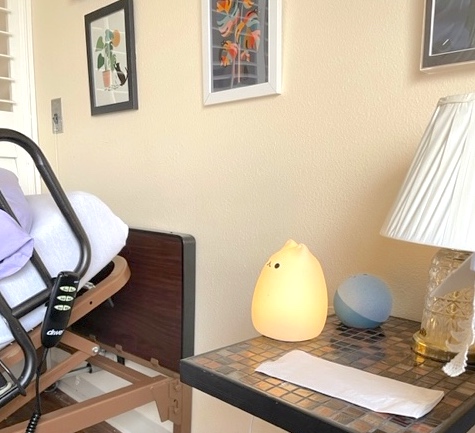
Peggy also hated her new hospital bed. Damn. I had been so excited that Kaiser approved its expense so quickly because it was keeping her safe—but she really couldn’t stand it.
There was definitely trouble brewing, and it had me concerned. [I’ve got a theory about it, and it’s not about bunnies (cue Anya from Buffy the Vampire Slayer).] Seriously, though, I know I believed that I was seeing an unmistakable pattern in Peggy’s moods, one that was just beginning to emerge. First, she would seem to be fine for about three days, then she would have a couple of mediocre days, and then a few downright horrible days. Then the cycle would begin all over again. I ran it by Michael, and he said he had noticed it too. So, it was probably not a coincidence.
So what could be causing this terrible cycle? And was there anything we could do about it? Those “downright horrible” days were especially concerning to us because they were marked by a lot of anger, the kind we had rarely seen before in Peggy. Apparently, she had fully reached the so-called Rage Stage of her dementia, now with extra hallucinations and delusions.
And, as if that wasn’t enough for us to deal with, less than a week later, Hell Day arrived.