
[TIMELINE: January 2024]
Visiting with Peggy was my top priority while I was in town, but I also planned to meet with the hospice team in person. I sat down first with the hospice social worker, Cristina. I really liked her. She advised us to focus on Peggy’s quality of life, and to be with her “in the moment” whenever we could, even if that meant just sitting beside her and being quiet. That’s a hard thing to do sometimes, she explained, noting that we should try to prepare ourselves for that.
Some of us on Team Peggy had already become adept at sitting quietly with her, but I described for Cristina what else we had been doing during our visits: reading to Peggy, talking with her, and playing her favorite music for her. Fortunately, Cristina told me that those were all exactly the right things, too. Then she advised me to bring more music. No problem—I was on it!
Cristina confirmed for me that Peggy was already well into Stage 7 in the progression of her dementia behaviors. I knew that, but it was nice to have her verification that my interpretations—of all I had read and then observed in Peggy recently—were more or less correct.
In Stages 7a–c, a person with dementia (PwD) has limited speech, and can no longer walk independently without assistance. That was where we were at now with Peggy.
Later on in the week, I met with Brian, the hospice chaplain. He was low-key and personable. An extra added bonus was that he was great with music, too, and helped to make sure Peggy got to listen to different music while he was with her. I liked him a lot. He was wonderful.
I also met Aruna, the registered nurse (RN) in charge, a.k.a. the hospice drill sergeant, which I mean as a compliment. When she was in the room, memory care staff marched to her drum. She was great with Peggy too, and Peggy responded well to her, which made Aruna happy. After only a few weeks on the job, she had become an amazing advocate for Peggy. She even got Peggy to take her meds without resistance, although she wasn’t as successful getting food into her.
Peggy’s reluctance to eat—and how that could dramatically hasten her death—came up often in my conversations with hospice staffers that week. It was a big issue, and we hadn’t solved it. As she continued to deteriorate, we kept looking for creative ways to address the problem.
Michael and I followed through on our plan to make spaghetti sauce using the family recipe that Peggy might recognize. Peggy loved spaghetti sauce, so Michael and I hoped our efforts would encourage her to eat more. We spent several hours in Michael’s home cooking the sauce from scratch—just like how my Mom, Peggy, and I used to make together.
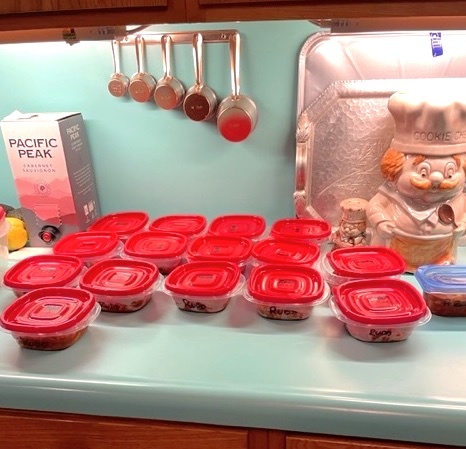
And into that sauce we added the tiniest little meatballs you could imagine, for protein. The meatballs were smaller than marbles, because I wanted to give Peggy a fighting chance of being able to eat them. We also added tiny bite-sized pieces of Italian sausages, because without them, the sauce wouldn’t taste right. Even if she couldn’t manage the sausage or meatballs, we were confident she could eat the sauce itself because it was a smooth liquid.
We made a lot of that sauce, and then we froze a good portion of it into little containers. If it turned out to be a success with Peggy like we were hoping, she would have it available for her until we could make another batch. It knew it was probably wishful thinking on my part, but I had to hope.
We brought some of the sauce with us to memory care the next day, and it was good thing we did! When we got there, Peggy was in the dining room completely ignoring the lunch placed in front of her. It was a sandwich cut in many pieces, but I could see just by looking at it that it was overwhelming for her. There were also chips. She hadn’t eaten any of it, which was not a surprise.
That’s when I brought out the spaghetti sauce. I told her what it was and was rewarded with a big smile. She was only able to manage a few bites but at least she ate something—and seemed to enjoy it. I let the caregivers know that there was more in the fridge.

We then had a front-row seat to some memory care weirdness. As we sat in the dining room, Marilyn (one of the other residents) walked by our table and asked if she could check Peggy’s plate. Before I could respond, she had picked it up and trotted off with it! She motored right out the door with it and into the garden. I didn’t know she could move that fast! It wasn’t really a big deal, as Peggy was never going to eat that food, but still. It was strange!
Then Marilyn came back inside without the plate, and began hitting one of the caregivers with a towel. It was more like play slapping, but it seemed like it could get out of hand at any moment. Sure enough, a few minutes later she began slapping him with her hands. She didn’t look angry, and she wasn’t yelling, but she seemed determined to hurt this guy. He was great with her, though. He got her to calm down, and deflected the slaps without harming her at all.
I overheard staffers talking, and it seemed that Marilyn had done this kind of thing before, though I had never seen her act out like that, and neither had Michael. It was just another one of those crazy disruptions that happens sometimes in memory care, where you just have to roll with it. But I was glad, for once, that Peggy and her hallucinations had nothing at all to do with the chaos.
In fact, Peggy kind of slept through all of Marilyn’s antics, so we decided we would move her back to her room. She was a bit agitated, but only because she didn’t understand at first what we were doing. She calmed down after she saw where she was. I sat quietly with her for probably 45 minutes while she dozed, until it seemed like she forgot I was even there.
Then Peggy started crying. Nothing had outwardly changed, so I didn’t know what was wrong. What was happening? I leaned over the bed rails and assured her that I was still there and wouldn’t be leaving any time soon. Then she said in a crystal clear voice, “this is bad, isn’t it?”
I was shocked. Peggy hadn’t had any moments of true lucidity in quite some time. Obviously, I didn’t want to upset her any more than she was already, so I split the difference. I admitted that things weren’t great, but I also said we were all working on making it better.
Then she said to me, “I used to be fine,” in her normal speaking voice. She wasn’t whispering or rambling. It was heartbreaking, and it compelled me to offer her a compassionate fabrication—I said we were also working on making her better. It was a lie, but I hoped it gave her some comfort.
Caregivers on AlzConnected often discuss these rare moments of clarity they witness in their PwD. Most find it disconcerting, but I didn’t. However, I was startled by it, and it caused a flood of mixed emotions that I needed to process. Which was the best way to look at things? On one hand, I was glad to know that Peggy was still in there somewhere. But I was also sad, because that moment of clarity caused her distress. The uncertainty left me feeling afraid for my sister.
In that moment, Peggy knew exactly what was going on. Was it the first time in a long time that she had that understanding? Or had she been aware always, this entire time, but rarely had the ability (or the opportunity) to express how she felt about things? When we had that memorable conversation, we were in her room with no music playing, and no one else was around. Maybe the complete quiet made it easier for her to concentrate? I didn’t know. I still don’t know.
After our lucid exchange, Peggy was completely worn out. She really needed a nap, so I told her it would be okay if she closed her eyes for awhile. I said I’d still be there when she woke up.
And I was there for her, the rest of that day and for another couple of days before I had to head home again. Before I left for the airport, Michael and I sorted out Peggy’s phone. Not only was Peggy done with the dentist, but the phone as well. It had all become just too confusing for her. I passed it to Michael so that he could retrieve all of Peggy’s contacts for us.
Not long after our sauce wins, Michael was able to have another good visit or two with Peggy, which I loved to hear about. Our brother Les even came by once while Michael was there, and she actually ate something! Not a lot, but there were tater tots and shrimp at the meal—Peggy food for sure—and she managed a couple of bites. Les was also able to get Aunt Betty on the phone again for a chat, so that was a big plus for Peggy. All in all, a good day.
I really appreciated the help from other friends and family members, some of whom who had begun ramping up the frequency of their visits lately, in getting Peggy to try eating. She needed nutrients so badly, so it was all hands on deck. And Michael and I resolved to keep trying, too.
A couple of days later, Michael was able to get Peggy to eat again. So Michael and I won! Well, at least from a certain point of view: Our sauce-making efforts were not in vain. I felt good about that.
Apparently, the sandwich that caregivers gave Peggy was too overwhelming for her (again), but our spaghetti sauce was not! She even ate one of the tiny little bite-sized pieces of Italian sausage that I had put in the sauce. And because the sausage is a little salty, she drank a lot of water.
It was a double win! Which was good—but not in the traditional sense of the word. You see, we were measuring things relatively now, so “good” meant only that something was less bad than everything else. We celebrated this “impressive” food and water intake, but in reality Peggy drank only about 2.5 oz of water total, and eaten maybe a quarter cup of spaghetti sauce, along with less than a third of a tiny, bite-sized piece sausage. So not nearly enough, but something.
It was becoming clear to me that a trial of puréed foods, a last resort, might be coming up fast for Peggy. But Brandee, the memory care director, had a great idea. She suggested that we move to a soft diet first, like scrambled eggs and soups. (And spaghetti sauce!)
Of course, not every visit this month was a success. Toward the end of January, our cousins Nikki and Dale visited memory care, and brought Peggy a nice sweatshirt, too. I was so psyched that they came by to see her! Sadly, though, Peggy was whispering and speaking gibberish at the time, and it wasn’t clear that she recognized either of them. They didn’t stay long that time.
Nothing about Peggy’s situation—or mood, or cognition, or abilities—was predictable anymore, if it ever was. Some days she ate a bite of food, and other days nothing at all. Some days she could enjoy visits from loved ones, and other days she was too agitated, or too sleepy, or too confused for that. At this point, every day was like some sort of terrible lottery, with no real winners.