
[TIMELINE: January–February 2023]
As January went on, my sister continued to have trouble processing our Uncle Nick’s death. It came out in some very weird ways. She started to wonder if her clothes belonged to her or Uncle Nick. What about her shoes? Were they hers or were they his? The first time Peggy asked me this I wondered how to reply, but then a fun metaphor popped into my head. I told her that her shoes were like Cinderella’s glass slippers—they would only fit one person: her. And since she had them on her feet they had to belong to her, not Uncle Nick. She liked that.
Often caring for a person with dementia is like performing improv. What they’ll say or do next is unpredictable, so you always have to stay in the moment and be looking for ways to respond. You do what you need to do and, if you’re lucky, you get it right on the first try. I knew the Cinderella reference was something Peggy would relate to, so it was the right thing to say at the right time. Then there were all those other times where I had no idea how to react, so I would just talk in a stream of consciousness until something resonated with her, and we’d go from there.
Like when she asked me who her hands belonged to, her or Uncle Nick; that stunned me. It was almost as if she couldn’t tell the difference between herself and him. Which parts of her body belonged to her and which belonged to him? It was deeply strange. She continued to ask me that, and she asked her bestie Michael the same, for weeks. Her questions certainly ramped up!
Michael guessed that maybe Peggy was asking about her hands because she recently got her nails done. Maybe her hands looked really different to her? Maybe? That made sense, but we couldn’t be sure. On the bright side, I mused, at least she had the chance to get a manicure! It was one way we could help her feel “normal” and reclaim a bit of her old life. Regular mani-pedis, just like wearing make-up every day, had been a ritual for her for decades before memory care.
The facility has its own little salon on the second floor; assisted living residents have easy access to it, but folks in the locked memory care unit can only partake of the services if they have an escort. Every couple of months, the director of the salon would come down personally to fetch Peggy, bring her upstairs, and do her nails for her. Tracy was great! I liked her, and I appreciated that folks still did nice things for Peggy—even if it potentially led to her being confused later.
At this point, confusion had become a running theme for Peggy anyway. Her perception was so off that she would develop these wild notions, which we were at a loss to explain.
The latest? She had insisted to Michael after breakfast one day that the staff were now serving people as part of the meal. Yes, actual people as menu items. But now it didn’t seem to matter to Peggy in the slightest—they might as well be offering pancakes, he said. Michael tried to tell her there was no way it could be possible, but Peggy wouldn’t budge from the idea. Had Peggy moved on from her lunchtime fear of being eaten to a matter-of-fact acceptance of breakfast cannibalism? We were definitely in the The Twilight Zone again; this time it was “To Serve Man,” the episode in which a seemingly benevolent alien race intends to cook and eat all of humanity on Earth.
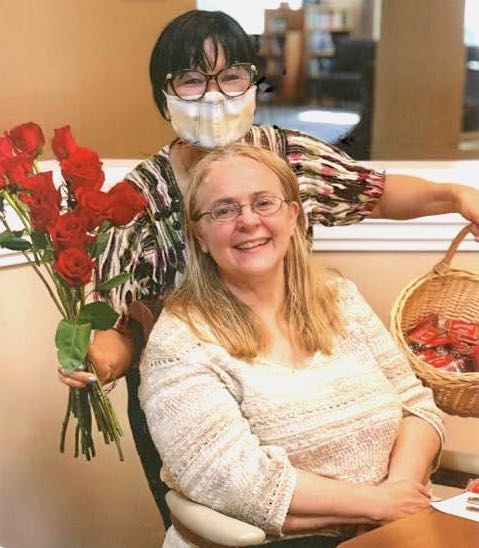
Yet Michael was amazing during all this surreality! No matter how off-kilter Peggy’s mind had become, I think he did an impressive job making her feel secure and safe during his frequent visits. I know he provided her with a steady, reassuring presence. While I would usually chat to Peggy about whatever came to mind during my phone calls and visits, Michael liked to read to her instead. We each had our own tactics for how to make Peggy’s life less horrible, but what was critical to both of us—and really, all of the staff in memory care—was trying to keep Peggy to a routine, something familiar and expected, as much as possible.
Infuriatingly, my brother Les was not on the same page; he was always the lone wolf doing whatever he thought was best. His surprise visit to see Peggy in January was a disruption, especially because he hadn’t been to her facility in so long. It’s not that I didn’t want him to see her, but he needed to be much more careful about how he interacted with her. It was actually very important to her that Les phone her and visit, but he didn’t know enough not to mess with her daily schedule. And he refused to believe how often that Michael or I would have to spend hours calming Peggy down after he carelessly said something random that upset her.
I know Les was trying to be helpful towards Peggy. I know he wasn’t purposely trying to derail her. But ever since her diagnosis, he would not listen to anyone. He wouldn’t listen to Michael or me when we’d say, “don’t do this” or “don’t do that” or “do this instead.” Invariably, he would say or do the wrong thing while still thinking he was right. But now that she was in memory care and deep in Stage 6 of her dementia, his stubbornness had a much bigger impact on her well-being.

So at my next regular session with my therapist Katy, after I updated her about everything, I asked her perspective on the big questions: Should I pursue guardianship and possibly block Les from seeing Peggy? Though it would require a lot of time-consuming paperwork and other steps, that was all within my skill set as an attorney. The main reason I didn’t really want to do it was because I knew that Peggy wanted to see Les. I wasn’t sold yet on the idea that it was necessary—but if it was in Peggy’s best interests to keep him away from her, I was ready to move forward.
I had already begun researching guardianship back in December, after Les told Peggy about Uncle Nick’s death even though I had warned him not to give her bad news about anything. But I don’t think that message ever penetrated with him. It never did! That was the final straw that had me looking further into legal options—I felt like I needed more control over his contact with her.
Katy suggested meeting with Les in person to get a read on him. Could I trust him to do right by our sister? If not, Katy suggested, then I should continue to keep guardianship in mind, but only as a last resort. It sounded like a solid plan, so I ran it by the innermost circle of Team Peggy: my partner Jon, Michael, and Dodie. Jon was as ambivalent as I was about it, while Michael, ever the diplomat, was silent on the matter. But Dodie was adamant that Les shouldn’t be allowed to see Peggy, because she believed some of the things he had said to her constituted verbal abuse.
I remembered Les speaking quite harshly to Peggy a number of times, too, but I don’t think he ever meant to be abusive. Objectively, I think it was just his normal method of communication, particularly when he wants what he wants. I don’t think anything he said was out of malice; he was just uninformed and wouldn’t do the work to become informed. But ultimately it didn’t matter. Even if it was just an obliviousness or lack of empathy on his part, the end result was the same. Peggy was fragile, and if you gave her bad news, she was going to spiral. It was as simple as that. I didn’t think I could trust him not to set her off. I didn’t want to prevent him from ever seeing Peggy, but I didn’t want him to damage her either. So I needed to get my ducks in a row.
Then two things happened back to back which led me to kick the guardianship decision even further down the road. The first was that Aunt Betty laid down the law (again) with Les about sharing bad news with Peggy, and he agreed (again) to behave. I took a wait-and-see approach, but this was still good to hear. Whenever Aunt Betty gave out “orders from headquarters” it carried a lot of weight in our family, even with Les. He would almost certainly comply.
This was key because Uncle Nick’s funeral was being planned for March. As soon as our cousin Nikki shared the arrangements with me, I immediately pleaded with everyone, including Les, not to tell Peggy about it, please. She would want to go, naturally, and there was no way we could manage a trip like that. Still to this day, I nearly break out in hives just imagining Peggy attending Uncle Nick’s funeral, and how terrible that would have been for everyone.
Later, I confirmed with Aunt Betty that Les was not going to say anything more to Peggy about Uncle Nick, especially about the funeral. I was stressed about it, but she put the pressure on and, thankfully, he kept his word. He did the right thing. But I remained vigilant, because I didn’t trust him. He destroyed that. I worried it was only a matter of time before he did say the wrong thing.
The second development was that I had a long meeting about the situation with Romarie, head med tech at Peggy’s facility, at my next visit in February, and she gave me some fantastic information. She explained that if Les persisted in giving Peggy bad news that she no longer had the wherewithal to process, the staff could step in and prevent him from seeing her. Part of Romarie’s job is to make sure all the memory care residents are healthy and happy, so her staff are always looking to see if visitors are harming a resident’s health or well-being—which arguably, Les had already done. The best part about it was that I didn’t need to have legal guardianship, or even a court order, to make this happen! I was so relieved. I decided to keep that bit of knowledge in my back pocket in case I ever needed it. It was a big weight off of my shoulders.
Sigh. When a loved one becomes a person with dementia (PwD), it can create so much conflict in families, a lot of it unforeseen. And in resolving those conflicts, sometimes you have to choose the lesser of two evils—but in this case, I didn’t know which course of action was which. Family was vital for Peggy, and I knew that not being able to see Les would increase her depression. But seeing him might also harm her because none of us could be sure what he was going to say!

Around this same time, I updated Peggy’s geriatric psychiatrist on how she had been doing and what our challenges were in keeping her mood stable. Dr. Phan said it might be a good idea to increase Peggy’s antidepressant (sertraline) again; this time it was meant to help her deal better with other residents and staff so that she wouldn’t lash out or yell at anyone. In a PwD, depression doesn’t present like it might in you or me or the average person; it often comes out as anger and aggression. Although that behavior had only surfaced a few times so far with Peggy, we wanted to keep staving it off for as long as possible. So I crossed my fingers yet again.
Fortunately, Peggy enjoyed a few good days in February, which I got to share with her during my visit. She looked somewhat better than when I had last seen her, and she only looped on questions about Uncle’s Nick’s hands and shoes (and her own) a few times. And though she was still worried about Aunt Betty’s health, I managed to redirect her to a lot of music-based activities, and that made for some cheery moments. Karaoke, obviously, was at the top of the list—if you put a microphone in her hand, the old Peggy would emerge, and it guaranteed she would be happy for a good while. Or we’d sit in her room and listen to 80s music like Duran Duran or Madonna, and that lifted her up, too. I loved that for her, seeing her give off a vibe of total contentment.