
[TIMELINE: AUGUST–SEPTEMBER 2021]
By August, my sister’s cognition had declined so much that even simple-sounding tasks could be challenging for her. Halfway through the month, we were concerned (again) that she might have a urinary tract infection. UTIs are often the cause of seemingly out-of-the blue bad behavior in PwDs, though once treated their cognition often goes back to baseline. The staff at her assisted living facility recommended taking her to Kaiser for tests. No problem, right? But it was actually so difficult that the entire endeavor ended up being traumatic for her, and exhausting for me.
The first thing I had to do was to get her in and out of the car. Peggy had lost her spatial ability, so she couldn’t find the seat even if I guided her into it. I had to be careful and patient, especially when I needed to maneuver her sideways. It was hard—she was almost completely dead weight, and at the time she had at least forty pounds on me. Once I got her seated, I moved on to her legs. I would pick up one leg and place it in the car, then the other.
She tried to help me, but ended up doing the opposite of what I needed: she’d plant her foot firmly on the pavement. I had to be super patient so as not to upset her. To get her out of the car, I had her hold onto my hands and I lifted her entirely. I really had to tighten those abs! My trainer gets a shout-out here for all the upper body and core workouts he had me doing. [Thanks, Mike!] All of this required maneuvering easily added a half hour to any trip I needed to take with Peggy.

We were at Kaiser for over three hours, including the half hour we spent trying to get Peggy to successfully pee in a cup. By the time we left, she was worn out, finished. She had nothing left. As for me? I was truly looking forward to sitting in stop-and-go traffic; I knew it was going to be way better than anything that had preceded it that day.
I didn’t feel good about putting Peggy through such an ordeal, but she needed to be checked for the UTI, and she needed the blood work done. Assisted living facility wanted the tests done, I wanted them done, and my therapist recommended them done as well.
Once I got Peggy back home to her facility, staff there actually told me they have available some sort of pee-catching device that we could have used. Why didn’t they say anything before we left? So aggravating! Kaiser’s RNs did successfully retrieve her sample, though, and it turned out she didn’t have a UTI. Lots of trauma, some of it needless, but at least we ruled that out.
A few days later, Peggy was scheduled to meet with her primary care doctor, which meant getting her in and out of the car again. I had thought about trying to combine the two visits on the same day but, ultimately, I was glad I didn’t. It would have been too much for her.
Fortunately, Peggy’s doctor was really good with her, and I liked her a lot. Prior to this visit, I had sent her a note explaining why we were going to be there and what we needed done so that I didn’t have to try to speak for Peggy. I wanted my sister to have as much agency as possible.

Once we were in the exam room with her, the doctor spoke directly to my sister, asked her questions, and only after that did she speak to me and ask for any necessary clarification. She discussed everything with Peggy that I had mentioned in my note, but made it look like they were all her own thoughts with no input from me. Peggy had no suspicions about how orchestrated that doctor visit really was. Her doctor gave her dignity and respect, and allowed my sister to feel involved in her own care. A small victory over dementia!
Later in the month, I had another meeting with Maria at the facility, the Carlton. She told me that Peggy had been waking up routinely at 5 a.m., which I wasn’t surprised to hear. Maria also said that Peggy was having “phone issues.” I had to laugh. I knew that was a major understatement.
As we continued preparing for Peggy’s move to memory care, one of the big questions that came up was what to do with her cat, Chloe, who could not accompany her there. Peggy’s friend Sue told me she had a lead on a potential home, which was good news. Sue also came through on another big issue. Since we couldn’t subject Peggy to long car rides anymore, I needed to find her a dentist closer to her facility—and Sue gave me the name of her own. I was relieved when I called them and confirmed that they were okay with treating PwDs. Whew.
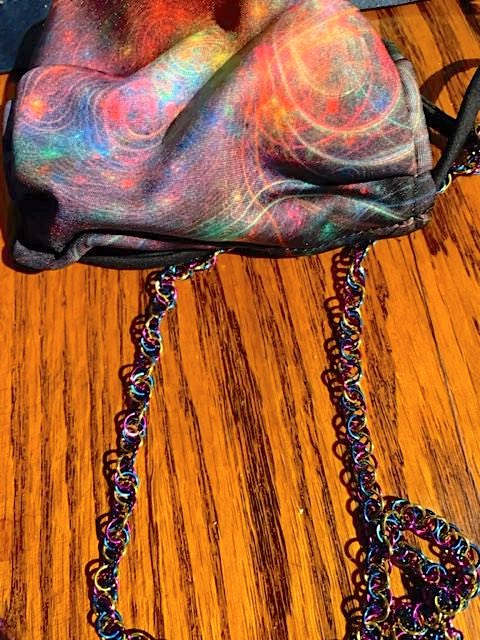
Whenever I was in town visiting my sister in person, I tried to do a couple of things that I knew would make her happy. In early September, she saw the mask I was wearing and loved it. So I got her the same one, wove her a special chainmail chain for it and solidly attached it. I figured this way, she could keep it around her neck and maybe be less likely to lose it. I wasn’t sure if it would work, so I was happy to see that it did (at least for a while).
I still think the mask is pretty cool—I got it at Electrothreads, for all your psychedelic art needs. It isn’t an N95, but I bought it during the time when N95s weren’t as easy to get.
September brought a lot of fear to Peggy. One day she was supposed to go to the memory care unit just for some activities, but no one (including me) could convince her that she wasn’t moving there permanently right then. There were many tears. We decided to bag the idea and try again some other day. Staff told me this was a typical reaction; there are often tantrums and meltdowns as PwDs move to memory care. In fact, for caregivers who live in the area near the facility, the general advice is to stay away for about a week after their loved one moves, until they adjust to the new environment. I understood. I didn’t like it, but I understood.
On another day not too long after, the facility again invited Peggy to participate in activities in memory care. She called me to confirm: If she went to the unit for this, would she get to come back to her apartment when it was over? I told her, “absolutely.” She asked me the same question probably half a dozen times over the course of our phone call, and I gave her essentially the same answer each time. (And at that point, my answers were 100% truthful.) She finally said, “Okay, I’ll go—and I won’t cry.” Not entirely the response I was aiming for.
I would have settled for her having an “okay” time, or even just “a time,” so long as her experience wasn’t a bad one. Still, I had hope she would enjoy herself. I hoped she would start to see that memory care wasn’t the nightmarish pit she always imagined it would be.
To my utter relief, Peggy called me once she got back to her apartment that day and said she had a good time at activities! Obviously, how a PwD views memory care (or any big change in their environment) is going to be unpredictable. What was fine with them yesterday might not be fine today, or might be great again tomorrow. But for now, things with Peggy were good.
During that first afternoon visiting memory care, Peggy got the chance to hang out with her friend and former neighbor, Ursula, and Peggy was excited to tell me that she looked great. I had seen Ursula myself when I toured memory care with Maria weeks before—and she actually had looked fantastic. Ursula was one of those tall willowy people who could wear anything and look amazing, and she happened to be dressed to the nines the day I saw her.
It was a big change from Ursula’s last days in the assisted living part of the facility, when she lived right next door to Peggy. At that time, she was often seen somewhat disheveled, with her clothes disordered, and that’s putting it mildly. Once, she had even wandered into the hall without wearing any clothes at all. Memory care had actually helped her fix all of that.
I found Ursula’s improvement really encouraging and, I think, so did my sister. Peggy was actually dipping her toes into the memory care experience, and finding out it wasn’t as horrible as she had once thought. I hoped this positive trend would keep going in the same direction.