
[TIMELINE: February 2023]
Despite sharing several nice, upbeat moments with Peggy early in the month, I was still pretty overwhelmed in February due to a number of new and worsening issues, all of which I just knew were harbingers of the challenges to come. I felt overwhelmed all the time.
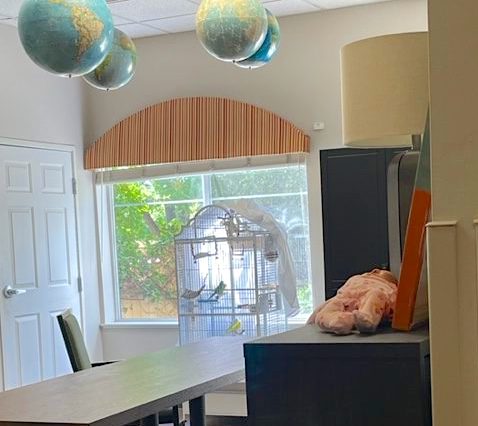
A few incidents were due to my sister’s failing perception and spatial awareness, some of which I personally witnessed during my visit. Her decline in these areas since I had last seen her was obvious. One day, Peggy and I were hanging out together in the memory care “dining” room. It’s actually an enormous mixed-use space that becomes a kind of recreation and activity area for the residents during the day, as needed. It has a modest kitchen located near the comfortable TV-watching area (furnished with at least half a dozen big stuffed chairs), and a large dining area filled with tables set in the center of the room.
Off in the corner of this space by the window stood a medium-sized bird cage, with a few colorful parakeets chirping happily inside. I pointed out the birds to Peggy, and she looked up, down, and sideways trying to locate what I was talking about—she looked everywhere but at the birds in the cage. So that was a bit of a setback. I didn’t want her to get frustrated, though, so I gave up on the topic altogether and found us a place to sit elsewhere in the room.
Other incidents this month appeared to be driven by Peggy’s increasing fear, as she became more and more detached from the world around her. The dementia brain is not only confused but fearful, and fear can trigger all sorts of distressing behaviors in a person with dementia (PwD).
For example, on a different day in the memory care “dining” room, Peggy and I were enjoying a TV documentary about Aretha Franklin and Dionne Warwick. I love those two women, and so did my sister. Peggy started to sing along with “Do You Know The Way To San Jose”—and I thought we were in a good place. But a couple of minutes later, she turned to me in a panic.
“I’m really afraid,” she said to me. “There’s just too many people here!” It was strange. We were sitting by ourselves all the way in the back of that entire vast space, and there were at most six other people there, all well across the room from us. And we weren’t even eating, which had been a frequent stressor recently for Peggy. I was baffled, but I got her out of there as quickly as I could.
The reasons why didn’t have to make sense to me; if I could redirect her and ease her fears or just improve her mood, that was what I was going to do. As a caregiver of a PwD, you need to just roll with things and try to keep up. But it takes effort! You have to read the person to figure out what’s going on with them this minute, this day. It might be the very same situation as last week or it might not. You just don’t know. Something may have broken in their brain since you last spoke to them! What was easy or fun for them last week might be scary the next. You have to pay attention.
On the last day of my visit, another troubling, fear-based behavior emerged. When it came time for me to start my long drive home, Peggy just would not let me leave. She nearly had a meltdown about it, so I delayed my plans to get on the road and tried to get her situated for the evening first. I walked her to the dining room for dinner, but then she told me she was afraid, again. Of being eaten? Nope. That the room was too crowded? Nope. This time, she said she was afraid because there were some residents there that she didn’t like, and she didn’t want to see them. I asked her if she’d feel better if I stayed with her through dinner and she said yes. And I stayed, of course.
That was my first experience with shadowing, which I’d never seen before with Peggy. I had read about it, though, as it’s a fairly common behavior for a PwD in the later stages, and members of my ALZConnected forum discussed it all the time. So I instantly recognized her being clingy with me for what it was. “Alright, we’re here then,” I thought. “I’ll just sit back down and try to be with her as long as I can.” It was frustrating, but I took comfort in the fact that at least we weren’t living in the same house together. That situation, I think, would have been so much worse; I expect she would have followed me around from room to room all day, which happens often with spouses.

The primary caregiver is like an anchor; without that, a PwD can become adrift in an increasingly distorted world. If a PwD doesn’t see their anchor person there in front of them, it can seem as if they are gone, so they never want to let that person out of their sight, not even for a minute. This is just how the dementia brain works in the later stages. I had to accept that Peggy was now living in a reality much different than my own. Technically, I already knew all of that, and that was why I stayed with her as long as I could. But knowing it and experiencing it are not the same thing. I was concerned, and I prayed that it wouldn’t become a common occurrence.
Unfortunately, near-meltdowns happened quite a few more times with Peggy (during every visit, on each of the days I was in town), until I learned how to leave memory care quietly. Thanks to my fellow caregivers on AlzConnected, who shared their best ideas, I eventually got a few tricks up my sleeve. My go-to strategy? Telling Peggy I had to use the restroom and assuring her that I would be right back—then I would leave the room quickly, then leave the facility, then drive away.
I won’t lie; I never felt good about that tactic. But the truth of the matter is that, once I was out of her sight, Peggy would forget I had even been there that day. Sometimes she would tell staff that she hadn’t seen me in months, when in fact it had only been minutes since I had been in the room visiting with her. It was your basic no-win situation.
In mid-February, Peggy fell again, apparently because of her extreme balance issues. At this stage of her illness, she typically leaned far over to the right when seated, and when she stood up she leaned waaay back. And if no one was around to help her, she was very likely to fall over—which was exactly what happened. She ended up in the ER, but thankfully didn’t break any bones.
When I talked to Peggy on the phone later on, she remembered that she fell, and that she had been in the ER, but she wasn’t sure how it happened. She was cheery, but her confusion was cranked up to 11, and she was extra word salad-y. It was the weirdest “conversation” ever.
Peggy believed she was making all kinds of sense, but I honestly had no idea what she was talking about. About all I can tell you is that her words were all in English. It was so stressful for me because I didn’t want to upset her. All I could do was agree with her (if and when that sounded like it was the appropriate response) or commiserate with her (when that felt appropriate).
Two days later, Michael and I touched base. He said Peggy’s morning had been rough, probably due to the stress of her ER visit, even if she couldn’t confirm that to us verbally. He also told me that she was confused about where her bedroom was, that her walking was unstable, and that she had the worst speech issues he’d ever heard from her—she didn’t make sense 97 percent of the time. The only good news he had for me was that her mood had improved throughout the day, and by the end of his visit she was on a much more even keel. That was nice to hear.
However, February still had a few more bad days in store for us. Later in the month, Peggy fell out of her bed in the evening. Memory care staffers called me at midnight to tell me about it, which I very much appreciated. Then she fell out of bed the next morning, too, so I got an early wake-up call about that, after which a lengthy discussion ensued about the need for a hospital bed and the possibility of ordering one for her. A bed with rails or half-rails was a pricey investment, but it could prevent future falls, so we hoped we could get it approved by Peggy’s insurance. Working out those logistics would have to wait a bit, though, as my eyes were barely open during the call and I hadn’t even had my morning tea. My tank was empty before I even got started.
But no matter how much I was struggling, it was so much worse for Peggy. The next afternoon, I was on the phone with her and she had an outburst. After about twenty minutes of effort, the staff and I were finally able to calm her down, and then she and I had a fine word salad conversation after that. I couldn’t tell you what we talked about if my life depended on it. Sigh. I really hated that feeling of spinning my wheels—effort without success. It was starting to grind me down.
Before the month was out, I got another update from Michael after his latest visit to see Peggy in memory care. He was such a wonderful friend to my sister her entire life, and especially during the years of her illness. He had been out of town the previous week and had not been able to visit, then upon his return, he saw some changes in Peggy. While not dramatic, they were very noticeable, and he wanted me to know. Here’s how he explained it:
Peggy was different than before, but I am hoping it is a one-off thing. She was in the front room sound asleep. Normally, she is a morning person. I am thinking she was again overtired. As you say, very “word salad-y” the whole time. The really strange thing is the way she moves now. We walked a lot every time. Outside in the summer, and back and forth in the hallway in the winter. She moves VERY slowly now. Tiny shuffle steps with lots of stops to stare.
I believe she was overtired and disoriented. I am hoping she will be better tomorrow, like what happened last time. We spent the majority of the time yesterday sitting on the bed talking about your family and looking at her pictures. Again, she just seemed like she was sleepwalking, nothing horrible. She has spatial difficulties and bumps into walls, even though I try to tell her before it happens and pull her closer to me. She just does not “see” things.
I really appreciated everything Michael did for Peggy, and also how well he kept me in the loop on how she was doing. There were so many details I needed to handle each week, and so much bleakness I expected on the horizon, that I felt drained all the time. At that point, I was sorely in need of respite. Even on the days when I’d wake up feeling relatively refreshed, my tank would immediately empty if anything dementia-related popped up…and it frequently did.
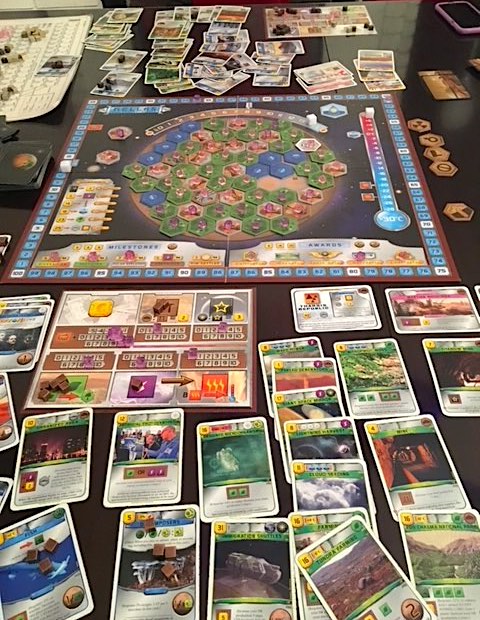
Lately, all my regular social haunts—like the gym or our favorite goth clubs in Seattle (The Mercury) and San Francisco (Death Guild)—weren’t really cutting it anymore. And our household’s go-to casual relaxation activity, playing board games, was no longer making much of an impact on clearing my mind. Everything that was happening with Peggy was just too overwhelming. My therapist Katy reminded me that things would not be like this forever—true, except we all knew that when it was over, Peggy would be gone. So, not a great thing for me to dwell on.
But Katy also suggested that we take a little mini-vacation somewhere local. Though easier said than done when you’re a weather wimp like I am and facing a winter cold snap in the Pacific North West, Jon and I agreed to consider some options. Perhaps a spring trip could be arranged?