
[TIMELINE: May 2022]
In May, our quiet reprieve came to an end as Peggy’s condition progressed—although, as with all of her previous Alzheimer’s symptoms, her new issues first appeared gradually.
By the middle of the month, my sister’s spatial relationship to objects (and to herself) had really changed. One afternoon during a visit, I took Peggy to relax in one of the memory care unit’s little sitting areas, which had comfy couches and a low, wide coffee table. I asked her to come sit with me on the couch, and she kept trying to sit on the table instead. I redirected her and redirected her, and finally she made it to the arm of the couch, but it took her a couple more tries to actually sit on the couch itself. At least she was good-humored about it.
Naturally, my discussions with Peggy became more simplified during this time. We didn’t really talk about anything of substance, current events, or complex ideas. Our conversation topics were mostly limited to the weather, what a great guy her friend Michael was, who she talked to on the phone last, and my nail polish. She would look at my nails, laugh, and then tell me how weird I was for having blue or purple nails. I’d pretend to be offended while I laughed with her.

Desiree, one of my sister’s caregivers, agreed. She said Peggy had appeared less aware of her surroundings lately and somehow seemed more “random,” in her opinion. I knew exactly what she meant. Desiree also said Peggy had gotten worse than she had been just a few days ago. My sister’s deterioration was becoming more noticeable, and accelerating.
In fact, sometime shortly after my visit, Peggy forgot that she had her own room, and thought that she was going to have to sleep on the couch in the memory care’s living room. She also forgot all about her crush. So I could see in real time Team Peggy’s recent lull come to an end, and our apprehension begin to set in as Peggy moved into a new phase.
To make matters worse, Peggy’s friend Ursula suffered a steep decline, and her family took her home to live with them. I learned later that a lot of families do that if they can; when a person with dementia slows down and is heavily medicated, they can be much easier to take care of at home. But at first, Peggy and Michael actually thought she had passed away!

In an email, Michael later explained to me what had happened that day. He and Peggy had walked by Ursula’s old room and discovered that it was almost completely emptied out, and her shadow box of family mementos had been cleared as well. What a shock for Peggy! Later, they spotted Ursula in the dining room, sleeping with her head down on the table. So it was not the end for her just yet, although it was still a really sad situation all around.
Around this same time, Peggy’s hated roommate Patricia also declined, both mentally and physically. She was on supplemental oxygen and was mostly bedridden. Michael met her son and got all the details, then updated me with the news. Alzheimer’s is relentless!
At the end of May, Peggy experienced what staff told me was an “unwitnessed fall.” Apparently, she was in another resident’s room when she slipped in the ensuite bathroom and couldn’t get back on her feet. Fortunately, she was completely unharmed. The caregivers helped her up and the on-duty nurse checked her vitals and made sure she had no scrapes or bruises on her knees—and then Peggy headed off to the living room for chair exercises as if nothing had happened. When I asked her for details later, she couldn’t remember much. And by the time Michael got there for his next visit, Peggy had completely forgotten the fall had happened at all.
So at this point, my sister’s short-term memory had evaporated—and her cognition levels were dropping, too. Usually when I told bad jokes (especially broad and obvious ones) to tamp down the stress, I would get a laugh out of Peggy. Now though, she sometimes didn’t get the joke at all, even jokes that she’d heard me tell numerous times before. I knew that a lack of comprehension would start to happen during this stage of dementia, so I was prepared to recognize it when I saw it. However, I was still shocked when it actually happened to Peggy.
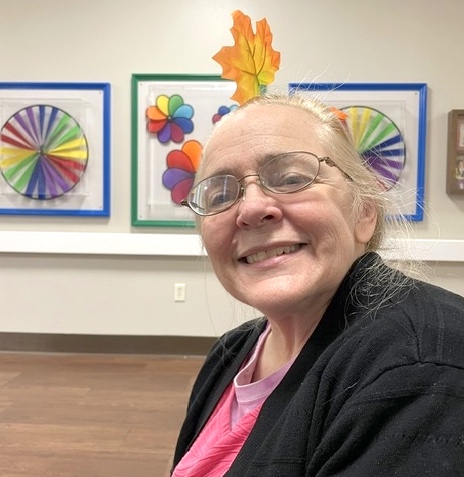
Typically, a person with Alzheimer’s declines over a period of about 8 years or more, but with early-onset, everything goes faster. My sister’s disease progression was just zipping along. I noticed it on a monthly basis, and as I increased the frequency of my visits, I could see it happening right before my eyes. That’s what made it alarming to me.
Another new development: Peggy’s emotions began to flatten out, far beyond anything that might have been caused by her antidepressant. Before this, she had always been mostly herself—perhaps a bit forgetful, with her speech full of word salad, but still noticeably Peggy. Now I was worried that her personality might change, with her lack of affect a harbinger of that.
To be honest, Peggy’s rapidly progressing (and new) symptoms were actually less distressing to her than they were to me! She was no longer frustrated or upset not knowing what was wrong with her. She was starting to forget that she had Alzheimer’s, which is itself a common symptom, known as anosognosia. In a way, that made things a little easier for all of us.
Even though the lull for Team Peggy was over, it didn’t quite feel like the cliff dive of the previous summer. We would still have to cope with a lot of upsetting changes on the horizon, but at least Peggy was not in any emotional distress. She was safe and surrounded with love.
Luckily she had great health care coverage that made her stay in memory care possible. If she hadn’t, I don’t know what we would have done. I didn’t ever want to take Peggy home with us; if we had moved her to Washington, the surroundings would have been completely unfamiliar to her. She would have lost access to all of the various friends and local family who visited, and to her friends in the facility as well. None of that would have been good for her.
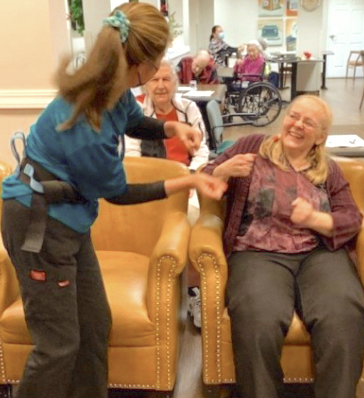
In San Jose, Peggy had so much support. Beyond her dear friend Michael, who visited multiple times a week, there were the staff caregivers at her facility, who handled her basic needs and helped her participate in various activities like the occasional karaoke session or the group exercise she did every day. Sure, as her disease progressed, all she could do was count along and bounce during chair exercises, but that movement was still helpful for her health and mind.
Then there was Liz and her niece Desiree, the two caregivers I hired from outside the facility to supplement my sister’s direct care. Liz had a full time job at Stanford, but she visited Peggy every Sunday, handled any personal shopping she needed, and generally acted as my eyes and ears. She texted with me often, so I always had the most up-to-date information and professional opinion on how Peggy was doing. Desiree also kept me in the loop; she would come by to care for Peggy more often, on days when Michael wasn’t there.
Even though I could only visit Peggy for a few days each month, we had someone special with her nearly every day of the week! It meant so much to me that we could do that for her.