
[TIMELINE: October 2022]
October is usually one of my favorite months, but everything was different in 2022. Normally, I would have been happily anticipating the spooky season, a special time of year for goths and an important anniversary month for my partner Jon and I, since we got married on Halloween. But instead, I was anxiously waiting for the other shoe to drop—and it did, in the worst way. That was the month that a cascade of cognition issues seemed to hit my sister all at once.
Although Peggy had regained at least some coherence after her Covid infection in June, she never quite returned to her previous baseline, which wasn’t a great situation. But I still looked forward to those rare surprise moments when sharper lucidity appeared out of the blue, when all of a sudden she would just be there. I liken the experience to a lamp with a frayed cord; if you manage to position the cord in just the right way, the light will switch on for a bit.
I could never predict which version of my sister I was going to get on the phone when I called, but every so often the stars would align and a coherent Peggy would emerge. However, if anything was out of whack with her physically or if she was particularly stressed out about something, her confusion increased and I’d only get word salad. Obviously, for Peggy to maintain any sort of cognitive reserve, it was imperative we all did whatever we could to keep things on an even keel for her, and to keep her stress levels down as much as possible.
So when Les told Peggy that our Uncle Nick wasn’t doing well, I was pretty upset. With our parents already gone (Mom in 2012 and Dad in 2015), Aunt Betty and Uncle Nick were more important to the three of us than ever and Peggy was, of course, distressed to hear the news. It stirred up some intense emotions for her—and as a result, her cognition took another big hit.
I just could not believe that Les had told her! And this was after I had specifically reminded him (and all of our relatives) again and again that, at this stage of her illness, it would be best for Peggy if we kept her out of the loop when there’s any especially sad or stressful family developments. What part of “Don’t ever give Peggy bad news!” did he not understand?
Not long after that, it became clear that Peggy was struggling more with perception and memory. For one thing, she started confusing her former roommate Patricia (who had died about four months earlier) with a woman named Mary Ann, another (living) resident in memory care. And she didn’t always know anymore where her own room was located; she couldn’t remember that all she had to do was walk straight down the unit’s center hallway and her room would be there on the right where it’s always been. Sometimes, she couldn’t even find the glass sliding door out to the garden, which was there in plain sight in the dining room.
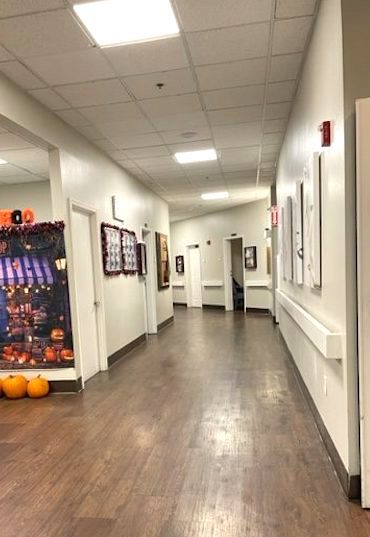
Peggy also started to get more agitated during meals because, as she put it, “there were too many people” near her. Apparently, when she tried to eat in the dining room she often felt surrounded—even if there were only a few other residents there. Which I thought was pretty strange, since the room was vast enough to include not just the dining tables but a TV lounge area with about eight big comfy chairs and a huge zone dedicated to residents’ daily activities.
Maybe her issues had something to do with the size and shape of the dining room? Maybe it was too vast? Was her poor eyesight making her anxious? Was it her worsening situational awareness? Was there just too much for her to focus on while she was trying to eat? Honestly, I had no idea. But from then on, Team Peggy sought out alternatives to the dining room for her mealtimes. Usually, we set up a little table in her bedroom, and that worked out much better for her. We’d close the curtains, put on some 80s music, and sit with her while she ate.
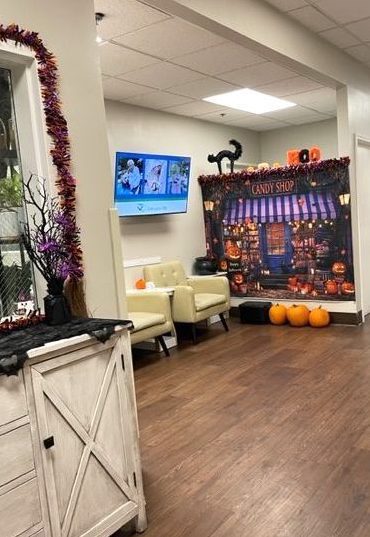
Once in a while, we would bring her to eat in the memory care lobby off the center hall; it had a nice wide reception area where she could sit and mostly be left alone. For some reason, Peggy was totally fine there even as people walked by, but people seated anywhere near her would really get on her nerves. It didn’t really make much sense, but we all just rolled with it.
Another noticeable change around this time was in Peggy’s walking—it was not quite a shuffle yet, but it was getting close to that. And as her vision continued to deteriorate, it inhibited her ability to get around. She just really couldn’t move well at all anymore.
It was tough to watch Peggy go through all of these trials. But I wasn’t sure how she felt about it all, or what (if anything) she noticed anymore about her various difficulties. It seemed sometimes that she still knew she had Alzheimer’s, while other times she appeared to have forgotten completely, a.k.a. the common dementia symptom of anosognosia. I was usually thankful when that surfaced, though, because it meant she was unaware of her deficits and therefore not experiencing any frustration or anxiety about her condition. That was a good thing, because October had a lot of drama in store for all of us, especially Peggy.
The first unsettling incident, early in the month, was the day my sister completely forgot her best friend for a brief time. I don’t think that had ever happened to her before, at least not with any loved one in her inner circle. Michael had come by to see her as he usual did—at least three times a week, he would visit pretty early and stay for hours, through lunch and afterwards—but on that morning she just did not know who he was at first. He was there with her in memory care for almost two hours before she recognized him even a little! He also told me that this was the first time he didn’t see “Peggy” when he spoke to her. Usually a lot of her real personality was still present when they interacted, he said, but not on that day. I know that was painful for him to experience, and it was painful for the rest of us to hear about, too.

When I talked to Peggy the following day, she definitely knew who Michael was—but she didn’t remember at all that he had just been by to see her. I didn’t know what to make of that. I think this was probably one of the most extreme examples I’d witnessed so far in Peggy of the infamous Alzheimer’s haze that takes over sometimes in a person with dementia. It was a dark shadow over everything, and all we (and Peggy) could do was wait for it to pass.
In mid-October, Peggy had another weird moment: she called to tell me that her hair was blue now, and she hated it and thought it was “icky.” She was so convincing over the phone that I actually wondered if maybe she had gotten into some blue dye somehow! My first reaction was to say to her, “I’m sorry you have blue hair now! But don’t worry; we’re going to take care of it!” Then I checked in with the memory care staff. Nope, she didn’t have blue hair. And when I visited Peggy in person not long after that, of course there wasn’t a blue strand to be found. I could see for myself that her hair was still as long and blonde as it had ever been.
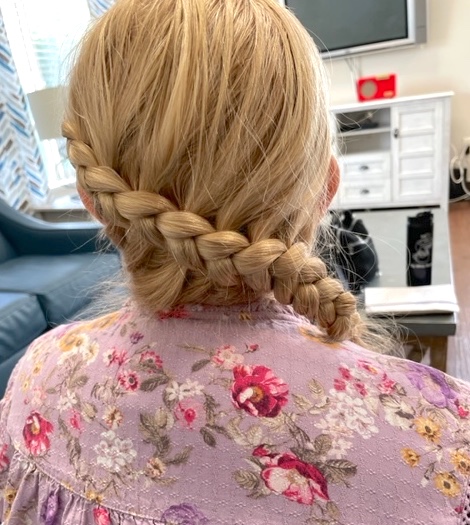
In fact, for months Michael and I had been referring to Peggy as Memory Care Barbie because she had such classically great hair—and she was also the youngest resident (by at least a decade) in the unit. I know she enjoyed that nickname a lot and thought it was pretty funny. It was apt, too, since Peggy often sported a glamorous hairstyle, courtesy of caretaker Sonia.
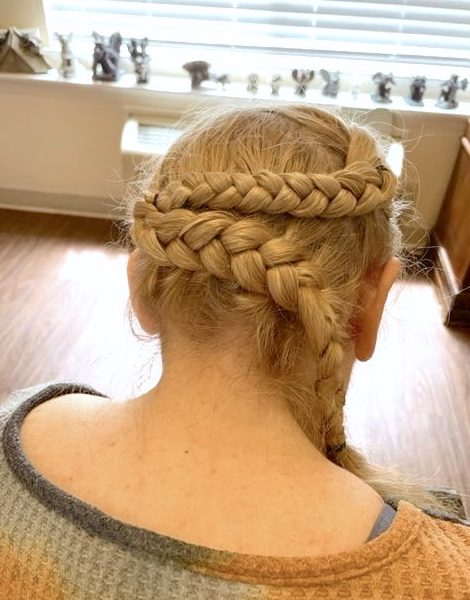
Sonia was incredible; apparently she had learned how to do all sorts of complicated hairstyles from watching YouTube videos. Whenever she was on shift in memory care, she would create these elaborate braids for Peggy. Once I saw those, I told Peggy that she had Game of Thrones hair. We would take photos of the back of her head so that she could see what it all looked like, and she loved seeing Sonia’s handiwork. I don’t think my sister had ever really watched the show, but she was familiar enough with a few characters and how they looked to understand the reference. We always got a smile out of her when she saw those photos.
Thinking back on it now, I am grateful Peggy retained clear memories of so many cultural and media references for years after she was diagnosed, even after her perceptions of reality started to slip. Even during the later stages of her disease, I could sometimes quote her a line from a TV show or movie that had once been an inside joke with us, and she still would know exactly what I meant. It remained a go-to coping mechanism for both of us for a long time. If anything was stressing Peggy out, I usually could turn to a little bit of pop culture humor to try to cut through it, and redirect her to another task or topic of conversation.
It was all part of the unique way my sister’s combination of early-onset Alzheimer’s Disease and frontotemporal dementia presented itself. I appreciated having another strategy in my toolkit that could sometimes help her, especially when things were at their most fraught. And more often than not at this stage of her disease, everything that was going on with Peggy seemed fraught in some way to me. Her perception levels were constantly shifting from day to day, so I had to learn to adapt quickly to meet her wherever she was at. And I was always on edge waiting for what was next, hoping I had the skills to navigate it for us both.
This was never more true than the fall of 2022. I had already reached near-burnout levels by the end of the summer, and as the weeks ticked by into fall, I continued to feel more and more overburdened. The stress was constant, but I wasn’t sure what I could do to lessen it. I figured my only option was to continue exercising self-care—eating well, visiting friends whenever I could, and exercising to the point where I practically lived at the gym.
I also spent a lot of quality time together with Jon. We paid our first visit to The Mercury, a private goth nightclub in Seattle, as guests of a friend, and enjoyed ourselves so much we became card-carrying members soon after that. I was happy we had a new local place to go to for music that could potentially become a special respite, much like the DNA Lounge in San Francisco had been for us for years. Unfortunately, my extensive self-care effort could only do so much. I thought it would be enough to lessen my burden, but all it did was take the edge off.