
[TIMELINE: August–September 2022]
By August, I felt like I was close to burnout. I think the biggest reason was that for months I had been constantly pretending to be something I wasn’t, or feel something I didn’t. On the phone with my sister, I’d work hard to maintain a pleasant, positive tone, always. And when I’d come down to visit her in memory care, the “me” that she saw would always be smiling, would always be speaking to her in an upbeat voice. In reality, I was usually feeling the opposite of upbeat, but I knew I had to be “on” for Peggy the entire time that I was there.
When you are the anchor for a person with dementia, they rely on you above all others to make them feel secure and safe and stable. You are the person they trust the most. It’s paramount not to do anything that disrupts that anchor, because that can agitate them or cause a meltdown, and that acting out is based on fear. You have to be sensitive to that, because they can’t change. Only you can change, so your focus when caregiving has to be about that.
When I became my sister’s anchor, I tried hard not to ever seem angry with her or upset, because that would trigger her fear—that maybe I would leave, that maybe she would be left all alone. I didn’t resent that about Peggy, though. There was no resentment on my part at all. That’s just the way it was. She no longer had the ability to regulate her own emotions, so I would have to make up for it. This was really important for me to do, but it required an enormous amount of effort, and after a few months it started to take an emotional toll on me.
A lesser reason for burnout, but still a genuine one, was that there was no real “off switch” for me whenever I got home. At least, not one that counted. Sure, I could be myself again for a while, which was a relief, but I still had to face the vast dementia bureaucracy and all the tasks that inevitably bubbled up to the top of the queue while I had been away. Even though I had made progress organizing my time better by bundling those tasks to specific days, it didn’t change the fact that there was constantly a ton of work that I had to do, and dreaded.
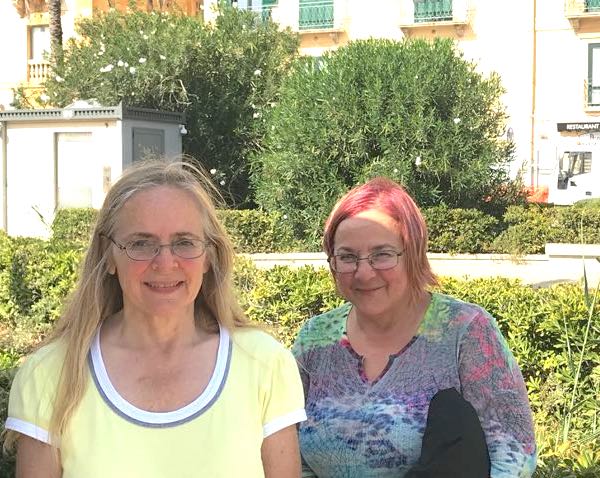
There was always something new to tackle, involving endless phone calls, emails, paperwork, meetings, and research. This included acquiring required documentation (or providing it), scheduling appointments, confirming medication refills and other details of Peggy’s care, doing her taxes, and verifying the pension and health benefits to which she was entitled.
But as always, there was at least some good sprinkled in with the bad, like Peggy’s birthday in September. That was a high point! A couple of weeks ahead of time, we began planning out some special surprises for her, including the perfect gifts. I remembered how much my sister loved the abstract paintings she had once picked out from my artist friend Madeleine a few years back, when they lived right around the corner from each other in downtown San Jose. Peggy brought them with her to the facility, and they held pride of place right over her bed. So that inspired me to try to find some additional artwork for Peggy’s room.
Dodie and I chose an artist who creates unique cat prints, which we thought Peggy would find cute, and spent an evening together on the phone paging through the online gallery. They’re quite charming! We finally agreed on this one and this one and then we had them mailed to Michael so he could frame and wrap them. I was psyched that we had scored some presents that we knew would make my sister happy. Go Team Peggy!
A week or two later, Peggy knew her birthday was almost near, even though she couldn’t remember the exact day anymore. “I’m coming up!” she told me on the phone. “Yes, you are coming up,” I confirmed, laughing. I wasn’t able to visit her on her actual birthday (due to some local appointments I couldn’t cancel), but we had planned to drive down to California a few days later. And in the meantime, I knew my sister would be in really good hands.
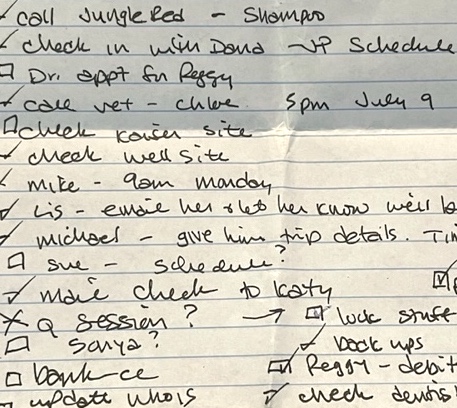
The memory care staff organized a small birthday “do” for Peggy, complete with the customary cake (albeit sans candles), which was a tradition in the facility. You knew if there was a birthday there would be cake, and cake always made everything better. Michael stopped by with some additional gifts he had picked out, and then once Rebecca (the director of activities), Facetimed me, we all got to sing “Happy Birthday” together. Dodie also called Peggy for her birthday, and a number of friends sent her cards. It was a great showing for Round One!
About three days later, Jon and I made it to San Jose in time for Peggy’s Birthday, Round Two, where we got to celebrate her again with Michael in her room. I loved watching her reaction to the artwork Dodie and I had picked out, as Michael opened them for her. She loved the cat prints! We hung them over her bed just below Madeleine’s paintings and they all fit so well together. They looked like they had always been there.
Moving into mid-September, Peggy looked good physically but she continued to decline mentally. I kept getting that weird sensation where I felt like I wasn’t on solid ground, that it could shift under my feet and things could go south at any time. It had been 11 months since I placed Peggy in memory care, and I knew that the state we were in was fragile. I was always waiting for another shoe to drop. Would it be a soft tennis shoe? Or a pointy stiletto heel?
My sister’s ability to speak was quite damaged at this point. Maybe it was the Alzheimer’s, or maybe it was the FTD and primary progressive aphasia. Maybe it was both. Either way, there were so many of her words that were just…gone. She kept falling back on her two common phrases—either “I don’t know how to say it” or “it won’t come out”—much more frequently. Or, when she managed to get a word out, sometimes it was actually gibberish. Sometimes it would sound close to the word she meant, like she would say kays or sees when she intended to say keys. Usually I could figure out from context what she was trying to get at, but sometimes it was a lost cause. In those moments, all I could do was nod my head and smile.

At this point, Peggy couldn’t comprehend compound sentences anymore, either. She couldn’t keep the first half of a sentence in her head while I spoke the second half, so I had to use much simpler language to talk to her. If I asked her a question, I always had to make sure that the answer could be “yes” or “no.” No more open-ended questions! Yet even after keeping it simple, I wasn’t always sure she was able to understand what I said.
Later in the month, Peggy and I witnessed a troubling incident in memory care. That part of the facility is one long hall that ends in a cozy living room. The hall is lined with doors to residents’ rooms on either side, until you get to the back where there are rooms on only one side.
We were sitting in the comfy chairs, looking out the windows and admiring the trees, when a woman I didn’t recognize and her husband walked by. The woman greeted Peggy by name. She seemed pleasant enough at first. Her husband clearly lived in memory care. They went into his bedroom, and she immediately started screaming at him, “If you won’t do what I keep telling you to do, I’m going to leave!” She continued to berate him for another 10 minutes. I was shocked to hear it. I knew that he probably didn’t understand much of what she said to him.
Later, they both came out of the room. One of the staffers happened to be nearby, and the woman lit into her about her husband’s underwear being too tight. Maybe she had been having a bad day, and this was the last straw? Regardless, I thought her aggression was really inappropriate in a space filled with people with dementia. I think she should have gone to the director (who was sitting in her office) with her complaint, rather than terrorize a caregiver who had no power whatsoever. And yelling at her husband was beyond the pale.

I knew that she was probably under a ridiculous amount of stress, but when your loved one has no ability to understand why you’re upset, they don’t know what to do. It’s not fair to them to lose your temper and create so much chaos in their presence, even if you’ve reached the end of your rope. So my first reaction was to be absolutely horrified.
Then I imagined that if I had been her, I’d probably go home afterwards and obsess over how much I shouldn’t have done what I just did, or maybe even hate myself just a little bit for losing it. Many caregivers do. Later, I considered that caregiving for a sibling and for a spouse differ in at least one key way: with a sibling, it allows for a little bit of space. But with a spouse, there is nowhere to run. You have to deal 24/7—and I’m not sure I could have done that.
So yeah, she probably was having a bad day. I could relate to that at least, because I was always having a bad day if I was in memory care. I couldn’t dress like myself or act like myself. I had to wear a gross pastel “uniform” and keep a smile plastered on my face. I had to be patient and calm no matter how stressed or worried I felt. In fact, in the moment that day, I tried to stay patient and calm in that situation, too. I sat there quiet and neutral, like Switzerland, until I realized how distressed by all of this Peggy was. Then I assured her that I’d never yell at her like that. Peggy responded quietly, “thank you.” It was a troubling experience for both of us.
Afterwards, I took comfort in the fact that I kept that promise. I never yelled at Peggy, ever. This was the one thing into which I put the most effort. Sure, I had failures all the way through my sister’s illness. I didn’t always get everything right. But I never lost it in front of her—even if I had to go lock myself in my car and scream. I still feel really good about that.